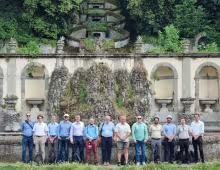
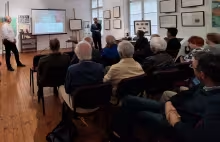
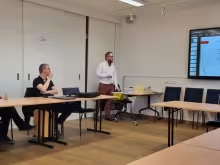
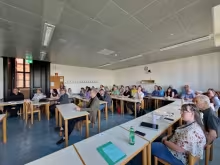
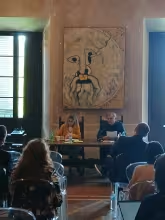
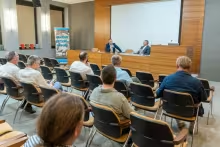
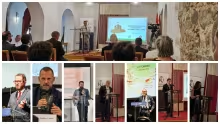
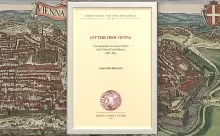
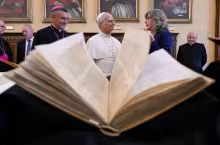
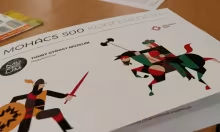
The Fraknói Research Group, in cooperation with Pázmány Péter Catholic University, the University of Pécs, the Pécs Regional Committee of the Hungarian Academy of Sciences, and the Collegium Professorum Hungarorum, organised the 12th Fraknói Summer Academy between 25 and 27 June. This year’s venue was the city of Pécs. The programme focused on late medieval Hungarian ecclesiastical history, centring on the forthcoming 500th anniversary of the Battle of Mohács and the preparation of the Bishops’ Lexicon of the Hunyadi and Jagiellonian periods.
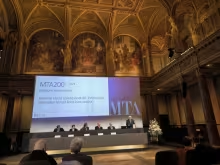
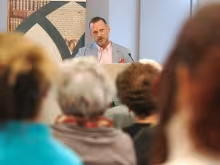
At the opening of the event, Péter Tusor, Head of the Research Group, welcomed the audience. He was followed by Prof. Márta Font, speaking on behalf of the Pécs Regional Committee of the Hungarian Academy of Sciences, who praised the achievements of the Research Group and its successful scholarly activities both in Hungary and abroad. Finally, Tamás Fedeles, Vice-Rector of the University of Pécs, Co-Director of the Fraknói Research Group and Chief Curator of this year’s Summer Academy, greeted the participants at the headquarters of the Regional Committee.
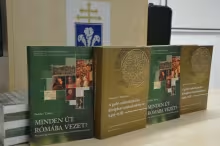
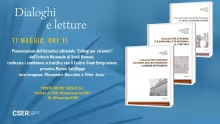
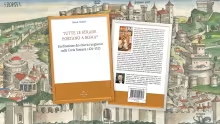
The opening session continued with a round-table discussion moderated by Kornél Szovák, Director of the Collegium Professorum Hungarorum, the publisher of the volume. During the discussion, editors Tamás Fedeles and Norbert C. Tóth presented the forthcoming Bishops’ Lexicon, scheduled for publication at the end of the summer to coincide with the anniversary of Mohács. They discussed the circumstances surrounding the preparation of the volume, the successful coordination of its twenty-two contributors, and the structure of the work, including its biographical entries and introductory essays on diocesan history. Following a presentation of the project’s principal findings and innovations—including the incorporation of newly identified Italian and Hungarian sources—the speakers also outlined their long-term plans, namely the preparation of further volumes covering historical periods not yet represented in the series.
The opening afternoon concluded with an interview conducted by Tamás Fedeles with László Felföldi, Bishop of Pécs, tracing the principal stages of the bishop’s life and vocation. The discussion touched upon his youth in the Nyírség region and his journey from a career as an electronics technician to the priesthood. Bishop Felföldi spoke at length about his appointment to the Diocese of Pécs, the concerns he initially experienced, and the hospitality of the local community, which greatly facilitated his integration into his new surroundings. The conversation also highlighted several important initiatives introduced since his episcopal ordination, including the diocesan men’s gatherings and the training programmes established for candidates preparing for the ministry of acolyte.
The following day, Tamás Fedeles opened the series of conference papers with a lecture entitled The Prelates of the Kingdom of Hungary at the Twilight of the Middle Ages. He surveyed the episcopal appointment policies of the Hunyadi and Jagiellonian rulers and the changes they underwent over time, highlighting the profound rupture caused during the reign of King Matthias by the loss of royal confidence following the conspiracy of humanist prelates against the monarch. He also presented the principal characteristics of the seventy-five bishops examined in his research, including their service to the Crown in diplomatic and courtly capacities, their social and ethnic origins, their educational backgrounds and peregrinations, and the dual loyalty that fundamentally shaped their careers: fidelity both to the reigning monarch and to the pope. In conclusion, he addressed the “prestige hierarchy” of the dioceses, as well as the relationship between spiritual authority and temporal wealth.
The next presentation was delivered by Tamás Pálosfalvi, Senior Research Fellow at the Institute of History, who examined the career of Dénes Szécsi, Archbishop of Esztergom (1440–1465). His lecture explored aspects of the archbishop’s political career that could not be discussed in detail in the corresponding entry of the forthcoming Bishops’ Lexicon. He therefore addressed the beginnings of Szécsi’s ecclesiastical career and the role played by his family during the civil war that broke out in 1440. Particular attention was devoted to the relationship between Archbishop Dénes and Governor John Hunyadi, as well as to the factors that fundamentally shaped this connection. The lecture also sought to answer two longstanding questions that scholarship has yet to resolve satisfactorily: why Archbishop Dénes failed to attain a more significant role in government after 1453, and whether the assumption that his relationship with King Matthias deteriorated after 1459 can be substantiated. The final conclusion of the presentation, echoing the assessment of Professor András Kubinyi, was that Dénes Szécsi was not only a conscientious churchman but also a moderate and respected statesman who played an important role in preserving peace during the turbulent decades between 1442 and 1464.
Norbert C. Tóth, Chief Archivist of the Hungarian National Archives and Head of the HUN-REN–MNL–SZTE Hungarian Medieval Studies Research Group, presented a paper entitled The History of the Archdiocese of Kalocsa-Bács between 1520 and 1529 (Part I: The Archbishopric under Royal Administration). His lecture examined the history of the archdiocese during the vacancy of the see between the death of Archbishop Gregory Frangepán in August 1520 and the appointment and subsequent occupation of the archiepiscopal seat by Pál Tomori in October 1522. Following Archbishop Gregory’s death, King Louis II immediately confiscated the revenues of the archdiocese and placed them under royal administration, directing them towards the war effort against the Ottomans. An excellent insight into this period is provided by six surviving registers, primarily produced in the course of administering tithe revenues. These documents record not only the collection of tithes village by village but also the allocation of these revenues in kind, including grain, flour and wine. The personal names preserved in these sources for the year 1522 were published by István Szabó in 1954 (Tithe Registers of Bács, Bodrog and Csongrád Counties), although the accounts themselves were not analysed. The registers make it possible both to reconstruct the economic and military functioning of the archdiocese and to gain a detailed picture, over the course of a quarter year, of the distribution of its revenues and expenditures.
Gábor Nemes, Director of the Győr Diocesan Collections Centre and Senior Research Fellow of the Fraknói Research Group, began his paper on the bishops of Győr in the late Middle Ages with an overview of the ecclesiastical topography of the episcopal city, which belonged at the time to a diocese of lower-middle-ranking income. He discussed the role of the cathedral chapter and of the bishop—whose residence remains in the episcopal castle to this day—in the life of the city, before analysing the origins, family backgrounds, education (including academic peregrinations and degrees obtained), and careers of seven bishops of Győr, from Ágoston Salánki to Balázs Paksi. He emphasised that the bishops of Győr generally emerged either from the ecclesiastical middle ranks—particularly from archdeaconries, provostships, and above all from the chapters of Buda and Esztergom—or from among royal officials and clerical diplomats in royal service. For many, the next step in their careers led to the more prestigious episcopal see of Eger or even to the archiepiscopal throne of Esztergom. In conclusion, he addressed the western humanist networks maintained by the bishops of Győr and their patronage of the arts, which found tangible expression, among other achievements, in the renovation of the cathedral.
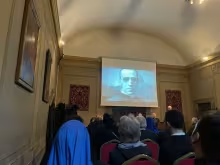
Viktor Kanász, Permanent Director of the Fraknói Academy, delivered his lecture The Diocese of Várad at the End of the Middle Ages in the unusual format of a live video call. The Assistant Lecturer of the Faculty of Humanities and Social Sciences at Pázmány Péter Catholic University, and researcher at both the Fraknói Research Group and the Military History Institute and Museum, examined the condition of the diocese in the decades preceding the Battle of Mohács. His presentation explored the diocesan administrative system, the functioning and revenues of its chapters, and the religious orders established within its territory. He discussed in detail the central role of Várad, the history of its cathedral, and the regionally significant activity of the cathedral chapters as places of authentication. In this context, he also highlighted the book culture of the diocese, the educational characteristics of late medieval Várad, its advanced cathedral school, and the university attendance patterns of clergy originating from the diocese. Particular emphasis was placed on the fact that Várad became a major pilgrimage destination owing to the tomb of Saint Ladislaus. Thanks to these factors, by the turn of the fifteenth and sixteenth centuries Várad had become the wealthiest bishopric in the kingdom after Esztergom, while also serving as the centre of a flourishing humanist milieu. In contrast, the period after Mohács brought dramatic change: as a result of the Protestant Reformation, Ottoman expansion, and the emergence of the Principality of Transylvania, Várad was transformed from a prosperous episcopal centre into a heavily contested frontier fortress within a war-torn region.
The lecture The Bishops of Veszprém in the First Quarter of the Sixteenth Century by Balázs Karlinszky, Director of the Archdiocesan Library and Archives of Veszprém, was presented in absentia through the interpretation of Csongor Cziráki. After outlining the condition of the Diocese of Veszprém at the close of the Middle Ages, the presentation introduced the bishops of the Jagiellonian period, highlighting among them Albert Vetési, one of the era’s most distinguished diplomats. The lecture addressed their social backgrounds, education, careers, and achievements both within the diocese and in national politics. Karlinszky also discussed several important monuments of the cultural history of the bishopric, including the Nágocs Codex preserved in the Archiepiscopal Library of Veszprém, the account book of the cathedral chapter, and the volume recording the decrees of the diocesan synod of 1515. The presentation concluded with a survey of material artefacts from the period, including the Vetési chasuble, the heraldic column capital known as the “Vetési Stone,” and several altars from Veszprém.
In his lecture on the key turning points of the career of László Szalkai, Bálint Lakatos, Senior Research Fellow of the Medieval Studies Research Group, expanded upon the biographical entry he had prepared for the Bishops’ Lexicon. He examined the atypical features of Szalkai’s career as a former financial administrator, economic expert, and royal secretary who eventually rose to the archiepiscopal see of Esztergom. Particular attention was paid to the combination of financial and chancery responsibilities that characterised his career, the factors behind his remarkably rapid advancement, and his participation in the royal campaign and the Battle of Mohács in 1526. The lecture concluded with an analysis of the identification and political symbolism of the Szalkai coat of arms based on impressions of his signet seals. The shield is divided horizontally: the upper field contains a demi-eagle facing dexter, while the lower field bears a floating heraldic fleur-de-lis. Although the colours of the arms are unknown, biographical evidence suggests that the eagle in the upper field was silver. This would indicate that, like several other influential royal confidants, Szalkai was granted the privilege of incorporating the eagle associated with the Jagiellonian dynasty into his coat of arms as a mark of special royal favour—a distinction fully consistent with the trajectory of his career.
Balázs Ternovácz of the Budapest City Archives examined the impact of Ottoman expansion on the functioning of the two southern missionary bishoprics of the Kingdom of Hungary in his paper entitled The Dioceses of Syrmia and Bosnia in the Shadow of the Ottoman Conquest. Originally established to support the missionary expansion of the Latin Church, the dioceses of Syrmia and Bosnia increasingly found their activities shaped by the advance of the Ottomans from the fourteenth century onwards. While the Diocese of Syrmia gradually lost its effective missionary function as a consequence of Ottoman territorial gains, in Bosnia pastoral responsibilities were progressively assumed by the Franciscan vicariate, even as the bishop continued to maintain his legal claim to jurisdiction over the diocese. The lecture demonstrated that the Ottoman conquest resulted not only in territorial losses but also fundamentally transformed the operation and role of these missionary bishoprics.
The presentations devoted to individual dioceses continued with a paper by Gábor Buják on the Diocese of Nyitra. He discussed the unusual organisational structure of the bishopric, founded in the early twelfth century, and analysed the development of episcopal revenues throughout the medieval period. These factors largely determined the extent to which the diocese contributed to the maintenance of cavalry contingents assigned to frontier defence. He concluded by examining the activities of two pre-Mohács bishops of Nyitra, István Erdődi (1504–1512) and István Podmanicki (1512–1530), focusing primarily on their roles in national politics and the defence of the realm. In his concluding remarks, Buják emphasised that although the Diocese of Nitra lay far from the regions directly threatened by Ottoman expansion before 1526, both the diocese and its bishops nevertheless contributed to the defence of the kingdom despite their relatively modest financial resources.
The conference concluded with a lecture by István Kovács of the Institute of National Heritage, who offered an overview of the history of the Diocese of Csanád before the Battle of Mohács, with particular attention to the activities of two of its bishops, Miklós Csáki and Ferenc Csaholyi. His analysis addressed the characteristics of diocesan administration, revenues, and religious life. The presentation concluded with a reconstruction of the careers and ultimately tragic destinies of these prelates, culminating, in the case of Ferenc Csaholyi, in the ultimate sacrifice on the battlefield of Mohács in defence of Christian Europe.
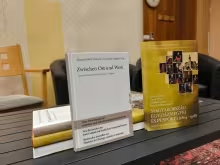
Following the conclusion of the scholarly sessions and the lively and productive discussions that accompanied them, Friday evening saw the traditional ecclesiastical history quiz that has become an indispensable feature of the Fraknói Summer Academies. This year four teams tested their knowledge in a wide-ranging competition covering diverse historical periods and topics. At the end of the contest, the prize-winning teams—as well as those who narrowly missed the podium—were able to select volumes from the Collectanea Vaticana Hungariae (CVH) and Collectanea Studiorum et Textuum (CST) series as rewards. Equally important to the unique atmosphere of the event were the informal conversations that unfolded around the dinner table and throughout the evening, bringing together students of Pázmány Péter Catholic University with the institute researchers and university lecturers participating in the conference.
On the morning of the final day, Gábor Bertók, Director of the Janus Pannonius Museum, delivered a lecture presenting the latest results of the archaeological investigations of the battlefield of Mohács. Following a brief historiographical introduction outlining earlier phases of research, he paid particular tribute to the pioneering work of archaeologists László Papp, Borbála Marác, József Szűcs, and Béla Kiss. He then discussed the role played by the museum in Pécs in the ongoing project, the results achieved thus far in the investigation of the settlement of Földvár, and the excavation of previously identified mass graves, especially Graves III and IV. The lecture also highlighted new methodological approaches in archaeology and the invaluable contribution of metal-detector surveys, which have brought about a decisive breakthrough in battlefield research. As part of the interactive presentation, participants had the opportunity to handle both an original fragment of a firearm recovered during the excavations and a modern replica.
Following the lecture, participants were given a guided tour by Gábor Bertók of the Janus Pannonius Museum’s permanent exhibition on the history of Pécs, entitled The Spirit of the Place – Genius Loci. The three-day Fraknói Summer Academy concluded on Saturday during a communal lunch, when the three curators—Tamás Fedeles, Péter Tusor, and Kornél Szovák—offered their closing reflections and expressed their hope of continuing the programme next year in Piliscsaba, more precisely at the Collegium Professorum Hungarorum. After 2022, the theme of the Thirteenth Fraknói Summer Academy, marking the beginning of a new five-year research cycle, will once again be the multifaceted relationship between Hungary and the Holy See.
Galleries: day 1 – day 2 – day 3
(Video recordings of the lectures may be viewed below and on YouTube.)
cover image : a Pécsi Egyházmegye honlapja
The Twelfth Fraknói Summer Academy was supported by the Faculty of Humanities and Social Sciences of Pázmány Péter Catholic University (Kut-23-6), the Collegium Professorum Hungarorum, the University of Pécs.
Poster