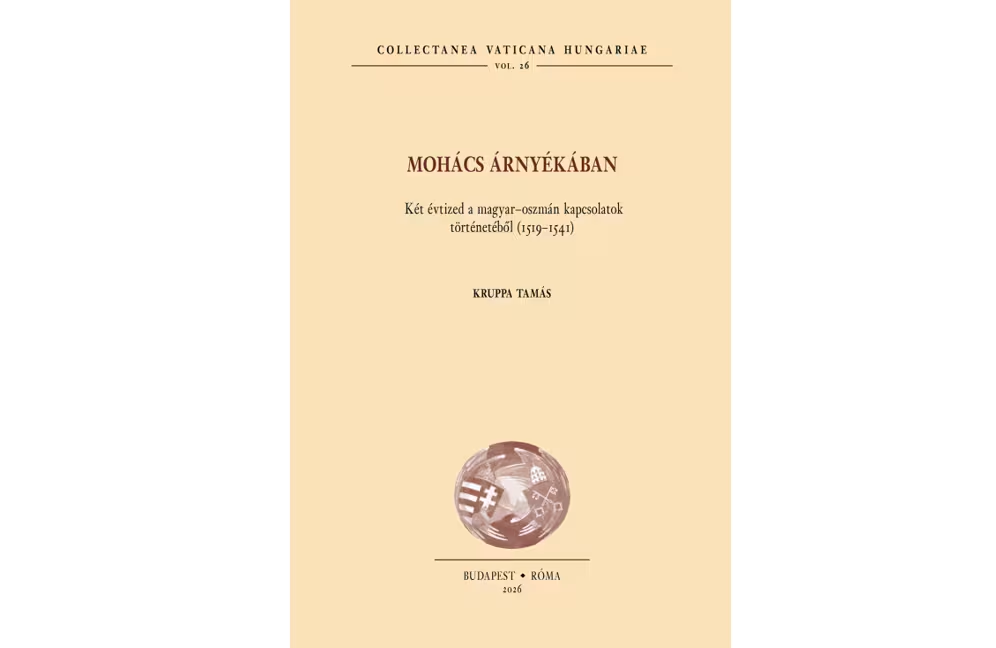
The latest volume of the Collectanea Vaticana Hungariae series (CVH I/26) has been published under the title In the Shadow of Mohács: Two Decades in the History of Hungarian–Ottoman Affairs (1519–1541). The work is the book version of the author’s doctoral dissertation submitted to the Hungarian Academy of Sciences from the University of Szeged in 2024 and successfully defended in 2025 under the title From the Jagiellonians to the Szapolyais: Two Decades in the History of the Kingdom of Hungary (1519–1541). The official peer review—comprising the reports of István Tringli, Tibor Neumann, and Pál Ács, together with the author’s responses—can be consulted here.
The research underlying the volume is the author’s individual scholarly initiative and does not form part of the core research agenda of the Vilmos Fraknói Roman Historical Research Group. Nevertheless, beginning in 2017 and in the spirit of the “Mohács 500” commemorative framework, Tamás Kruppa received substantial FTE support within the Research Group for the collection of materials and the conduct of his investigations.
The book introduces a considerable body of newly examined sources—primarily from Rome and Venice—into the historiographical discourse and brings the half-century-long debate surrounding the so-called “Süleyman offer” to a new level. The choice of subject may be considered particularly bold, since the period of the Battle of Mohács belongs to the most intensively researched epochs of Hungarian historiography. Methodologically, the study moves beyond the conventional frameworks of Hungarian historical scholarship and approaches the events from a novel analytical perspective. On the basis of diplomatic sources, it advances the thesis that before 1526 all relevant actors—the Ottomans, the Jagiellonians, and the Habsburgs—acted pragmatically and to the best of their knowledge in shaping their respective foreign policies. The work argues that the long-standing explanatory model which contrasts a weak Hungarian political elite with a centuries-long Ottoman strategic design—and interprets the defeat at Mohács accordingly—is untenable.
The source base of the investigation consists of both previously published and newly identified Italian diplomatic texts. Owing to their distinctive rhetorical turns, these documents are not merely dispassionate descriptions of events; through their stylistic choices and silences their authors themselves shaped the course of developments. Consequently, they can be interpreted correctly only through careful, multi-layered decoding. On this basis, the monograph proposes a new interpretative framework, examining Hungarian–Ottoman relations between 1519 and 1541 from the perspective of the vassal relationship imposed upon Hungary by the Ottomans.
The e-book version of the volume can be downloaded here.