2025

  • 2025. October 22.

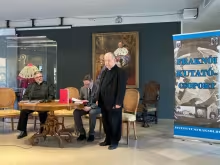
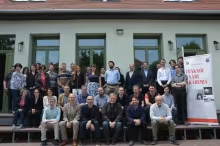
    The Fraknói Research Group at the First International Congress of the History of Dioceses in Lisbon

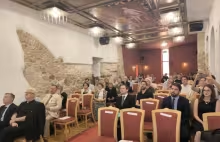
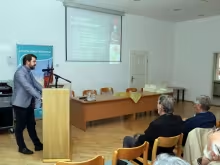
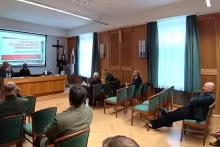
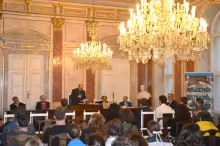
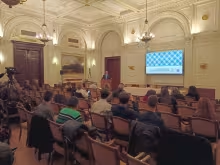
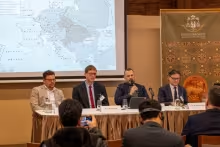
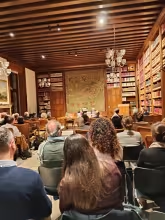
    The Centro de Estudos de Historia Religiosa of the Catholic University of Portugal (Lisbon) and the História, Territorios, Comunidades  research centre of the University of Coimbra jointly organised the First International Congress of the History of Dioceses, held in Lisbon from 22 to 24 October 2025.

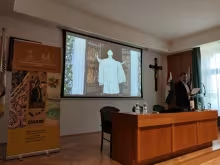
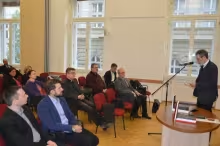
    The three-day scholarly event took place in the auditorium of the John Paul II Library on the campus of the Catholic University of Portugal. The organisers aimed to provide a platform for presenting and discussing new achievements in ecclesiastical historiography. Moreover, the extended “Questions” sessions scheduled at the end of each panel – considerably longer than is customary in Hungary – offered valuable opportunities for in-depth discussion, comparison, and interpretation of the papers presented.

    Fruitful exchanges of ideas took place among participants from Portugal, Spain, Italy, France, and the Czech Republic, reflecting the event’s distinctly international character.

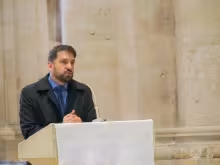
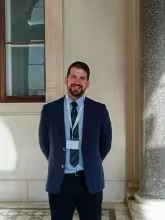
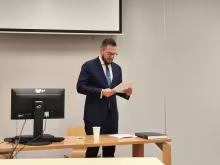
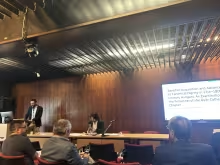
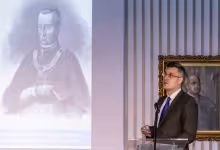
    The Vilmos Fraknói Vatican Historical Research Group was represented by Róbert Oláh P., who, following the recent conferral of his doctoral degree, participated as a Research Fellow. His paper, delivered on 22 October, was entitled: “Benefice Acquisition and Advancement to Canonical Dignity in 17th–18th-Century Hungary. An Examination of the Personnel of the Győr Cathedral Chapter.

    In his presentation, he outlined the main findings of his doctoral dissertation, introducing new research results concerning the relationship between the lower clergy of the Diocese of Győr and the cathedral chapter, the system of commendations, the conditions of advancement within the capitular hierarchy, and the influence of the Habsburg dynasty on appointments to canonical offices.

    The conference papers are expected to be published in written form in the course of the coming year. The cooperation newly established with the Catholic University of Portugal has its roots—like so many others—in parallel research activities carried out in the Vatican Archives.

    Programme


    4566
  • 2025. October 15.

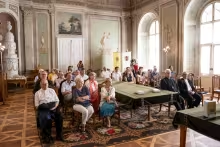
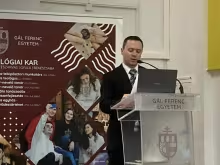
    On October 14–15, 2025, the Gál Ferenc University hosted a conference entitled Holy Years and Jubilees, organized by the university’s Bálint Sándor Research Group for the Study of Religious Culture and the History and Ethnography Section of the Saint Stephen Academy of Sciences.

    In the afternoon session of the first day, György Sági, Scientific Secretary of the Fraknói Research Group, participated as a speaker. His presentation, titled Half a Century of Holy Years from the Perspective of Kalocsa (1900, 1925, 1950), offered a brief overview of the measures and decrees issued by the successive archbishops governing the Archdiocese of Kalocsa-Bács during the three ordinary Holy Years in question—György Császka, Count Gyula Zichy, and József Grősz. In conclusion, the lecturer outlined how the jubilee years unfolded within the archdiocese under their leadership.

    (Photographs by Adél Lakatos.)

    The conference abstract booklet and program are available for download.


    4557
  • 2025. October 21.

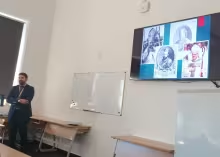
    The National Committee of Hungarian Military Historians held a conference entitled Military History Research in Hungary at the National University of Public Service on 20 October 2025. At the event, Viktor Kanász delivered a presentation entitled Nunciature Reports as Sources of Military History.

    In his lecture, he demonstrated that from the late Middle Ages onwards, the Papacy established one of the most efficient diplomatic networks in contemporary Europe. The nuncios assigned to various courts regularly sent reports to Rome, often on a weekly basis. He explained that within Hungarian military historiography, it has been primarily the reports of Nuncio Burgio from the years 1524–1526 that have been exploited. These vividly illustrate that, in addition to ecclesiastical and political information, the correspondence also contains highly significant material of military historical relevance.

    Nevertheless, the reports of the nuncios from the post-Mohács period remain largely unknown to military historians, even though they provide particularly valuable sources for the conflicts between John Szapolyai and Ferdinand I, as well as for various stages of the anti-Ottoman struggle. Moreover, in later periods as well — for example, in connection with the events of 1664 or the wars of liberation — these documents continue to possess considerable historical value.

    PROGRAM

    4541
  • 2025. October 2.

    On October 2–3, 2025, the University of Hradec Kralové and the University of Pardubice held a joint international conference on the early modern period entitled "Three centuries in the heart of Europe. European Aristocracy in the Early Modern Period".

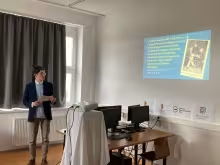
    On the first day of the academic symposium in the Czech Republic, Csongor Cziráki, intern at the Fraknói Research Group and scholarship holder at the CPH Hungarica–Vaticana Research Group, also gave a presentation. The title of his presentation was "Trent Reform, Turkish Threat, Family Building. Catholic Prelate on the Frontiers of the Habsburg Empire (Bishop György Széchényi of Veszprém, 1648–1658)." In it, he presented the pastoral work of György Széchényi at the head of the Diocese of Veszprém through his correspondence with Ádám Batthyány, with particular emphasis on his role in the struggle against the Ottomans. He presented the archbishop's role as a dynasty founder and builder by comparing him to his contemporary, Archbishop Ernst Adalbert von Harrach of Prague, thus placing Széchényi in a European context.

    In addition to high-quality presentations and fruitful discussions, on the first day of the two-day conference, participants visited the diocesan episcopal archives in Hradec Králové, and on the last day, they took part in a guided tour of the Pardubice Castle.

    The presentations will also be published in written form in the journal of the University of Pardubice (Theatrum Historiae).

    The slides from the presentation held in English can be viewed here, and the conference program can be viewed here.

    (The photos were taken by Lucie Smolková and Radek Plžík.)

    4542
  • 2025. October 14.

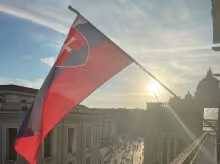
    On Thursday, 9 October 2025, at 6:00 p.m., the Slovak Historical Institute hosted the book launch of Dejiny slovenského historického výskumu v Ríme [The History of Slovak Historical Research in Rome], authored by Ivana A. Petranský, a research fellow of the Institute. The event was moderated by the Slovak historian Beáta Katrebová Blehová. The Fraknói Research Group was represented on this occasion by Katalin Nagy, CPH fellow and resident researcher of the Group at the Vatican Archives.

    The volume offers a comprehensive overview of the history and role of the Slovak Historical Institute in Rome from the post-1918 period to the present day. Since its foundation, the Institute has served as a key platform for Slovak historical scholarship to engage with the European academic community and to establish research relations in Italy – particularly through the systematic use of archival sources preserved in the Vatican.

    The book provides a detailed account of how, from the very establishment of the Czechoslovak Republic, there was a strong ambition to represent the new state’s sovereignty also through the foundation of an institute in Rome. As a result of this initiative, the Czechoslovak Historical Institute was created between 1921 and 1923. This made it possible for Slovak historians, alongside their Czech colleagues, to conduct internationally relevant research both in the interwar period and thereafter, with special emphasis on the study of medieval sources.

    After the Second World War, the Institute’s activity was repeatedly interrupted for political and financial reasons. During the Cold War, its intellectual tradition was sustained in Rome by Slovak émigré scholars and Catholic circles. From the 1960s onwards, new generations of researchers appeared who worked in Italian and Vatican archives; the book also presents in detail the scholarly achievements of several of these notable Slovak historians.

    Following the political changes of 1989 and the attainment of Slovak statehood in 1993, new opportunities opened up for Slovak historians. The Slovak Historical Institute in Rome was established with joint state and ecclesiastical support. It received legal status in 2013 and has operated as an institutional body since 2014. Its academic background in Slovakia is provided by the University of Trnava [Nagyszombat]. Since then, the Institute has been continuously active in various academic and editorial fields: organizing source-based research in Vatican and Italian archives, hosting conferences and symposia, and publishing journals and scholarly volumes.

    “The book places particular emphasis on the most recent research directions and projects, and on the ways in which the Institute contributes to the development of Slovak historical consciousness” – as stated in the main thesis of the presentation.

    * * *

    To this report, and especially to the closing sentence quoted above, it must immediately be added – from the standpoint of scholarship – that it is of paramount importance for Slovak historical research to ensure that its aspirations remain in full harmony with the authentic historical reality prior to 1918.

    The successor institutions of the former Czechoslovak Historical Institute are, without doubt, functioning effectively in 21th-century Rome. Unfortunately, this cannot be said of the Roman Hungarian Historical Institute, which began its activity in 1924 in the Villa Fraknói, and whose work, already by the 1930s in the Palazzo Falconieri, had virtually ceased. Within the Hungarian Academy in Rome, the 'Istituto Storico Fraknói ' – which still nominally exists within the Collegium Hungaricum – engages in no visible or active scholarly activity whatsoever.

    In contrast, Czech historical research has operated within a stable institutional structure since the 1990s. Within the Institute of History of the Czech Academy of Sciences, a commission composed of scholars with extensive research experience in Rome constitutes the Prague-based academic foundation of the Czech Historical Institute in Rome. The Institute itself shares premises in Rome with the Czech Ecclesiastical Institute. It publishes its own periodical (Bollettino dell’Istituto Storico Ceco di Roma) and maintains several newly established as well as long-standing series of scholarly publications (for all this, see the Institute’s official website). To our knowledge, the Czechs do not maintain a so-called “cultural institute” in Rome.

    The Slovak Historical Institute, by contrast, began its operation in 2014 within the building of the Slovak Institute in Rome – an institution comparable to the Hungarian Academy in Rome, directed by diplomats and serving primarily as a cultural center. In 2023, it relocated to the Via della Conciliazione, in the immediate vicinity of the Vatican. The new headquarters, both representative and functional, had previously served as the Vatican residence of the late Curial Cardinal Jozef Tomko. It attests to the high level of Slovak ecclesiastical and state attention, as well as to their effective institutional representation in Rome, that they succeeded in acquiring this residence for their historical institute. The Institute’s own Roman periodical is entitled Slovak Studies.

    Both the Czech and the Slovak Historical Institutes are members of the distinguished international association uniting the scholarly institutes of Rome.

    4540
  • 2025. October 8.

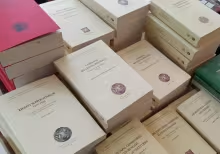
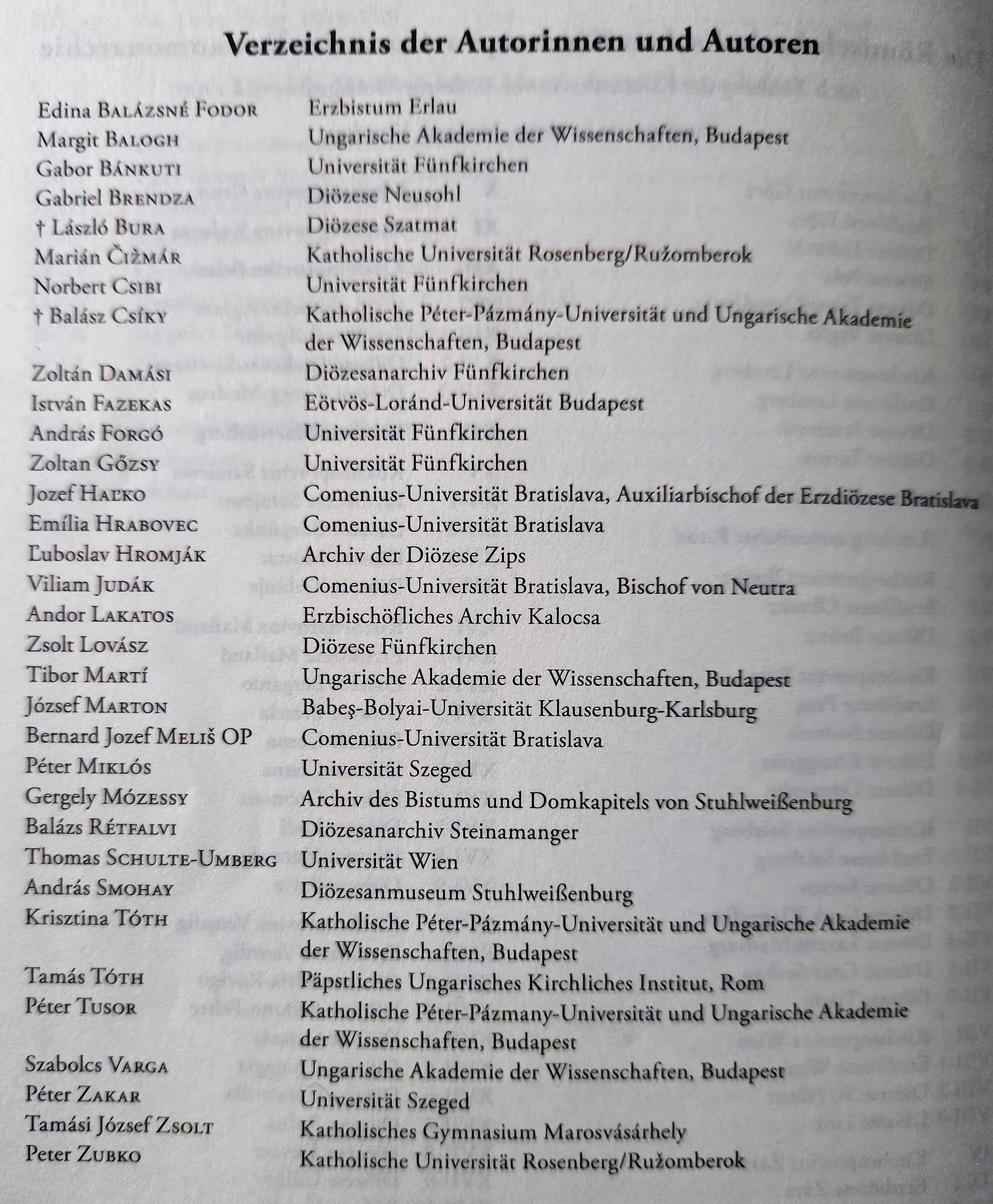
    On 8 October 2025, following the Székesfehérvár event, the presentation of the Lexicon of Bishops 1804–1918 (Magyarország egyházmegyéi és püspökei (1804–1918). Intézménytörténeti és életrajzi lexikon I–IV (CST I/7) szerk. Szirtes Zsófia–Tusor Péter–Rupert Klieber, Budapest 2025) took place in the ceremonial hall of the Central Seminary in Budapest. The volume was published as part of the large-scale project of the Fraknói Research Group. The basic research underpinning the publication had already been carried out within the framework of the Lendület programme of the Hungarian Academy of Sciences, concluded in 2017. The first results of this research were published in German in Berlin (Duncker & Humblot, 2020); the present, revised, expanded and updated Hungarian edition represents an advanced continuation of the earlier academic project.

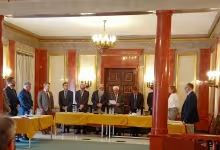
    The numerous attendees – including students of Pázmány Péter Catholic University – were welcomed by Bishop-Rector Levente Balázs Martos (Central Seminary) and Dean Nándor Birher (Faculty of Humanities and Social Sciences, Pázmány Péter Catholic University). Auxiliary Bishop Martos noted that he was able to hold the freshly published volume in his hands on the very day of its release, as the Fraknói Research Group’s Budapest base is located in the Seminary building itself. (In its time, under the presidency of Cardinal Lajos Haynald and through the efforts of Vilmos Fraknói, the Vatican Hungarian Historical Commission also held several of its sessions in the same Chapter Hall.) The bishop emphasized that the exemplary lives of the predecessors presented in the lexicon provide him with true guidance.
    Dean Birher highlighted that, as he has personally experienced, artificial intelligence will not be able – for a long time, if ever – to offer such a coherent synthesis and scholarly evaluation of the key figures of 19th-century Hungarian church history as the authors of this lexicon have done.

    On behalf of the Hungarian Catholic Bishops’ Conference, Bishop Zsolt Marton of Vác – former rector of the Central Seminary – also addressed the event. Drawing on the example of his own diocese and its former bishops, he emphasized the lexicon’s significance in deepening and preserving local Catholic identity. He added that unlike most reference works, this volume can be read continuously, since it successfully combines academic precision, synthetic perspective, and readability. Among his examples from the history of the Diocese of Vác, he highlighted the well-crafted biography of Piarist Bishop Konstantin Schuster, namesake of the main square of the episcopal city.

    The scholarly merits of the volume were assessed by László Csorba, former Director of the Hungarian National Museum and of the Hungarian Academy in Rome. With an engaging presentation, he placed the biographical entries within the broader context of 19th-century liberalism and Catholicism, the tensions between Catholic autonomy, the liberal state, and royal patronage, as well as the long-debated issue of clerical stipends (congrua). He drew attention to the lexicon’s distinctive arrangement – by ecclesiastical provinces rather than alphabetically – which allows readers to gain an organically structured and historically accurate picture of the Hungarian episcopate of the period.

    A speech was also delivered – through the interpretation of Zsófia Szirtes – by Professor Rupert Klieber (University of Vienna), head of the international project. He explained that the revised Hungarian edition of the Bischofslexikon, first published in Berlin in 2020, contains detailed biographies of 128 bishops and outlines 170 episcopal tenures, as every fourth prelate advanced to another, usually more prosperous diocese. This allows, for the first time, a comprehensive overview of the Hungarian high clergy, providing valuable insight into the complex structure of the country.
    “The lexicon is methodologically outstanding in several respects,” emphasized the Austrian church historian. “It offers a comprehensive overview of various source materials: the diocesan archives located in present-day Hungary, Slovakia, and Romania, processed by eminent scholars from all three countries; as well as the records of the central archives in Vienna, Budapest, and Rome, and the press sources of the Austrian National Library, now available digitally and evaluated by researchers of the University of Vienna. Another major merit of the work is that it does not confine itself to state and ecclesiastical politics – such as privileges, foundations, or the recurring debates around marriage and education laws. It also integrates cultural and social-historical perspectives, and makes a conscious effort not to recount history as that of men alone.”

    Professor Klieber also noted that beyond their often princely lifestyles – marked by summer residences, travels, and medical treatments – the bishops made wide-ranging and socially beneficial use of their considerable economic resources. The main field of investment, understandably, was education: 87% of the bishops supported schools, which in Hungary were largely under ecclesiastical supervision. This was followed by increasingly professional forms of charity (68%). Many prelates also contributed to scientific (34%) and cultural life (27%), while more than half (60%) acted as patrons of architecture. About a quarter placed particular emphasis on spirituality or supported flourishing female congregations, and nearly one third (31%) maintained special closeness with the Pope and the Holy See. (The full text of Professor Klieber’s speech is available here in Hungarian and here in German.)

    The event concluded with the words of Péter Tusor, co-editor of the lexicon and head of the Fraknói Research Group, alongside Zsófia Szirtes and Rupert Klieber. Tusor explained that in the title Lexicon of Bishops 1804–1918, the indication “I–IV” refers not to volume numbers but to chapters, corresponding to the ecclesiastical provinces of Esztergom, Kalocsa, and Eger, and to the exempt Archabbey of Pannonhalma. A fifth, separate volume will later cover the Greek Catholic dioceses and bishops, expected to appear in early 2026. This closing volume will also include an alphabetical concordance for all five chapters, prepared by Olivér Kőhalmi.

    Among his acknowledgments, Tusor emphasized the key role played by his former student, Zsófia Szirtes, a graduate in history and German studies, in the success of the nearly fifteen-year undertaking. As a member of the Fraknói Research Group – operating at Pázmány Péter Catholic University with the support of the Hungarian Academy of Sciences (MTA) and ELKH/HUN-REN, under the joint leadership of Professor Tamás Fedeles (University of Pécs) – she served as the Hungarian project coordinator of the international enterprise.

    Tusor further pointed out that within the broader international ecclesiastical-historical project aiming to compile similar lexicons for the entire Habsburg Monarchy (1804–1918), only the Hungarian volume has so far been completed. In his concluding remarks, he referred to the coincidence that the event, held on the feast of Our Lady of Hungary, followed a public demonstration in front of the university’s main building on Mikszáth Square the previous evening:
    “We express our solidarity with the Dean regarding recent and yesterday’s developments. Between 2009 and 2011, a less fortunate turn occurred in the life of the Faculty, and partly in that of the University. We are now witnessing its predictable consequences. In this contrast, today’s book presentation most clearly reveals what the true scholarly identity and mission of the Faculty of Humanities of the Catholic University in Budapest really are,” he stated on behalf of himself and the Fraknói Research Group.

    The musical accompaniment evoking the atmosphere of the 19th century was provided by István Bácskai, Director of Gondolat Publishing House, who performed Liszt’s Hungarian Rhapsody No. 3. At the end of the event, the participating authors and collaborators – including student members of the CPH Hungarica–Vaticana research group – received their complimentary copies amid enthusiastic applause from the audience.

    Encouraged by the success of the project, and in connection with the recent rise of Mohács-era studies, work has begun under the direction of Professor Tamás Fedeles, in collaboration with the Collegium Professorum Hungarorum, on the Lexicon of Bishops of the Jagiellonian Period (reported earlier here).

    The published volume is available for download here.
    The German edition can be accessed here.
    The full video recording of the book launch and all speeches can be viewed below.


    POSTER

    INVITATION

    4524
  • 2025. September 30.

    Organized by the Veszprémi Szemle Urban History Public Benefit Foundation, the launch event of the 78th issue of the Veszprémi Szemle urban history journal was held on 26 September 2025 at the Eötvös Károly Library. At the event, Viktor Kanász, research fellow of the Fraknói Research Group, delivered a lecture entitled “I Know My Sheep” – Episcopal Visitations of the City of Veszprém from the 18th to the 20th Century.

    In his presentation, he outlined the origins of the institution of canonica visitatio, its history in Hungary, and the main stages of its scholarly investigation. He then presented the visitation records pertaining to the Diocese of Veszprém, briefly discussed the 1778–1779 visitations he has edited, and turned to the records surveying the diocesan center itself.

    In this context, he explored the historical memory reflected in the visitations of the 18th to 20th centuries—especially the 1552 occupation of Veszprém, the reorganization of the cathedral chapter, and the perception of each era by its contemporaries. He also addressed the rich data contained in these sources, which provide valuable information for archontological and demographic research, as well as insights into the material culture of the time, including local libraries. Furthermore, with regard to the educational history of Veszprém, he examined the role of schoolmasters, and finally demonstrated how the emerging communist dictatorship can be discerned between the lines of these records.

    (Photo: Zsolt Zachár & Csongor Cziráki)

    4473
  • 2025. October 1.

    Organised by the Hungarian Military Science Society and the “Szülőföldünk” Local History Association, the conference entitled “Győr County in Hungarian Military History” was held in Győr between 29 September and 1 October 2025, with Gábor Nemes and Viktor Kanász representing the Research Group.

    On the first day, Gábor Nemes reconstructed the military unit of the Győr Cathedral Chapter on the basis of data drawn from the chapter’s medieval account books for the period 1495–1528. He demonstrated that although the Győr Chapter was not among the landowners obliged to maintain military contingents under Act 20 of 1498, from 1502 onwards it demonstrably employed mercenaries. These included both cavalry (heavy and light) and infantry soldiers, each with their own captain and banner. The payment of wages, as well as the provision of weapons, clothing, and food, placed a considerable financial burden on the canons, who had to cover war expenses not only through the war tax but also from their own private revenues. Nemes precisely reconstructed the process of mobilisation and the division of military responsibilities within the chapter.

    On the second day, Gábor Nemes conveyed the greetings of András Veres, Bishop of Győr, after which Viktor Kanász gave a lecture entitled “Maurice of Saxony and the Győr Encampment of 1552.” In his presentation, he explored how Maurice’s 1552 Hungarian campaign was interpreted in an overwhelmingly negative light by both contemporaries and later historians and writers. He examined why King Ferdinand I or the archduke did not lead the forces, how the previously rebellious duke eventually marched to the Hungarian theatre of war as a Habsburg ally, and what is known about his encampment at Győr and the fortification of the town. He also discussed in detail the forgotten raid on Esztergom, analysing its short- and long-term consequences.
    (A more detailed treatment of the topic can be found in the 2023 issue of Arrabona.)


    Gábor Nemes' lecture

    Viktor Kanász's lecture 

    4445
  • 2025. September 18.

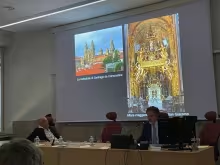
    On 18–19 September 2025, the international conference “Giubileo e giubilei. Arte, mete e riti tra Roma e Santiago di Compostella” (“Jubilees and Holy Years. Art, Destinations and Rites between Rome and Santiago de Compostela”) took place at Sapienza University of Rome, Faculty of Humanities, in the “Adolfo Venturi” lecture hall. The event was jointly organised by the Embassy of Spain to the Holy See and Sapienza University, bringing together a number of renowned scholars to explore the cultural, religious, and artistic dimensions of Roman and Compostelan jubilees. The Fraknói Research Group was represented by Katalin Nagy, our Vatican archival research resident.

    The two-day programme featured keynote lectures on the origins and theological significance of jubilees, as well as their cultural manifestations from antiquity to the twentieth century. On the first day, Sapienza researchers Marina Righetti and Gaetano Lettieri introduced the emergence of the earliest jubilees and the concept of the Holy Doors. Manuel Antonio Castiñeiras González, professor at the Autonomous University of Barcelona, presented the history of the Holy Doors in Jerusalem, Rome, and Compostela.

    The second session of the conference was chaired by Paolo Caucci von Saucken (University of Perugia, Honorary President of CIECS). The lectures focused on medieval Roman pilgrimage sites, iconography, and religious narratives, with special attention to the cult of Saint James. Anna Maria D’Achille and Antonio Iacobini (Sapienza University) discussed the earliest traces of the Saint James cult in Rome. Pasquale Iacobone (Pontifical Commission for Sacred Archaeology) spoke about the Church of Saint James near the Colosseum and its wall paintings. Marco Piccat (CIECS, University of Trieste) offered a new interpretation of medieval pilgrimage literature, analysing “Eastern stories” written for Western pilgrims — including the legendary journeys of the Apostle Saint James and Saint Veronica from Asia to Europe.

    In the afternoon, the third and fourth sessions examined the cultural, artistic, and religious significance of jubilees from the Renaissance to the present day. The sessions were chaired by Mario Bevilacqua (Sapienza University) and Miguel Taín Guzmán (University of Santiago de Compostela). Philine Helas (Bibliotheca Hertziana – Max Planck Institute, Rome) analysed the history and role of the Church of Santo Spirito in Sassia, one of the most important Roman jubilee constructions, which held a special place in official ceremonies. Miguel Taín Guzmán (CIECS, University of Santiago de Compostela) presented the celebration of Holy Years in the Renaissance and Baroque periods, focusing on processions, ceremonies, and popular festivities accompanying pilgrimages — key scenes of urban religiosity and political representation. Ilaria Fiumi Sermattei (Pontifical Gregorian University, Rome) discussed the jubilees of the nineteenth century, highlighting the period’s political, social, and religious crises and the renewal efforts expressed through jubilee practices. Francisco Singul (CIECS – Xunta de Galicia) spoke about the “renaissance” of Compostelan Holy Years and pilgrimages between 1885 and 1920, showing how the Camino de Santiago experienced a revival at the dawn of modernity. Piotr Roszak (Nicolaus Copernicus University, Toruń) examined the meaning of jubilee pilgrimages in the contemporary world, interpreting pilgrimage as a spiritual and communal experience that continues to shape identities today. Giovanni Papi (Centro Studi sulla Cultura e l’Immagine di Roma) focused on the impact of twentieth-century jubilees on Roman art, demonstrating how jubilee years transformed the city’s visual and urban landscape. Barbara Jatta (Director of the Vatican Museums) presented the institution’s role in preparing for the 2025 Jubilee, emphasising the importance of cultural heritage displays and jubilee-related exhibitions.

    The final session concluded with a discussion, followed by the solemn closing remarks of Manuel Antonio Castiñeiras González, who summarised the main findings of the conference and highlighted the continuing relevance of studying jubilees from historical and cultural perspectives.

    conference's program

    4529
  • 2025. September 27.

    On 23–24 September 2025, the conference Western Transdanubia Before and After Mohács took place at the Nádasdy Cultural Centre in Sárvár. From the Fraknói Research Group, Viktor Kanász participated in the organisation; in addition to him, the large audience could listen to papers by Tamás Fedeles, Gábor Nemes, and Tamás Kruppa.

    In the first session, chaired by Viktor Kanász, Gábor Nemes presented the military expenditures of the Cathedral Chapter of Győr between 1500 and 1526, based on data from the chapter’s medieval account books. He established that although the Győr chapter was not among the landowners obliged by Act XX of 1498 to maintain a military contingent (bandérium), from 1502 onwards the presence of mercenaries can be documented. Among these mercenaries were both cavalry (heavy and light) and infantry soldiers, each with their own captain and flag. The payment of wages and the provision of weapons, clothing, and food placed a heavy financial burden on the canons, who had to finance the costs of warfare not only through the war tax but also from their own revenues.

    Tamás Kruppa delivered a paper entitled The Turkish Threat in Croatia and Slavonia Before Mohács: What Do the Venetian Sources Reveal? Based on texts from a previously unknown codex containing Venetian diplomatic reports, he demonstrated that in response to the outbreak of the Second Ottoman–Venetian War in 1499, the Republic of Venice concluded a triple anti-Ottoman alliance with the Kingdom of Hungary and the papacy in 1501. Within the framework of this league, the Kingdom mobilised its entire military force in the Hungarian–Ottoman border war of 1501–1502. The nearly year-long military operations were made possible by the regular arrival of Venetian and papal subsidies. In the end, due to the war itself, Venetian naval operations, and problems in Anatolia, the Ottoman side offered peace, which was concluded in 1503 and lasted for about seven years. The main strategic goal—weakening and pushing back Ottoman power—was not achieved. In addition to preserving the Banate of Jajca, the greatest achievement was a new treaty under which the Venetian Republic committed itself to pay an annual subsidy of 30,000 gold coins for Hungarian border defence for the duration of the seven-year peace. In practice, these payments continued regularly until 1521.

    On the second day, Viktor Kanász gave a lecture entitled The Nuncio Would Return: Giovanni Antonio Burgio’s Mission to Hungary in 1527. He presented the nuncio’s activities, with special emphasis on his little-known attempt to return to Hungary in 1527, using several previously unknown Burgio letters preserved in the Vatican Apostolic Archive and the National Archives of Hungary. He also discussed the diplomatic mission of Tamás Kamarjai, sent by Ferenc Batthyány to Italy, during which he visited Venice and Rome and came into contact with Burgio. Kanász placed these events in the broader context of post-Mohács relations between the Holy See and Hungary.

    In his lecture The Lord of Németújvár on the Southern Frontier, Tamás Fedeles focused on Lőrinc Újlaki, a former lord of Németújvár (today: Güssing, A) who actively participated in the defence of the southern borderlands. After presenting the prince’s military contingent (bandérium), he examined Újlaki’s first documented anti-Ottoman campaign in the early 1500s. He then discussed in detail his activities as co-Ban of Belgrade (1510–1513) and his participation in the military events of 1521–1523 Zvornik, Nándorfehérvár, Szávaszentdemeter (Zvornik, Belgrade, Sremska Mitrovica).

    The written versions of the conference papers will be published in the spring of next year.


    PROGRAM


    4455
  • 2025. September 14.

    On the afternoon of 11 September 2025, a double book launch was held at the Somogy County Archives of the Hungarian National Archives. On this occasion, alongside Éva Knapp’s volume Regeneratio et constantia. Egy 18. századi dél-dunántúli település, Mesztegnyő újjáéledése az egyházi források tükrében (Regeneratio et constantia. The Revival of an Eighteenth-Century Settlement in Southern Transdanubia, Mesztegnyő, in the Light of Ecclesiastical Sources), a source edition by Viktor Kanász, research fellow of the Fraknói Research Group, entitled A veszprémi egyházmegye egyházlátogatási jegyzőkönyvei 1778-1779. III. Somogy megye (The Visitation Records of the Diocese of Veszprém, 1778–1779. III. Somogy County) was also presented.

    The audience was welcomed by Tamás Polgár, Director of the Archives, followed by Balázs Karlinszky, who introduced Éva Knapp’s volume. Subsequently, Zoltán Gőzsy presented the Somogy visitation records published during the summer. In his remarks, he emphasized both the importance of institutional cooperation and of publishing source editions. He also referred to the background of the visitation (the already published volumes on Zala and Veszprém Counties) and to the manifold possibilities for utilizing the edited sources.

    As a conclusion to the event, a roundtable discussion was held, moderated by Tamás Polgár, with the participation of Balázs Karlinszky, Zoltán Gőzsy, Viktor Kanász, Éva Knapp, and Dusán Barnabás Hegedüs, who discussed the archival conditions of historical research in Somogy County. During this session, Viktor Kanász also provided a brief overview of medieval, early modern, and twentieth-century sources concerning Somogy County preserved in the Vatican Apostolic Archives.

    Following the presentations, Tamás Polgár guided the young fellows of the Research Group through the collections of the Archives.

    Bibliographical data of the presented volume:

    A veszprémi egyházmegye egyházlátogatási jegyzőkönyvei 1778–1779. III. Somogy megye. Közreadja és a bevezető tanulmányt írta: Kanász Viktor, munkatárs: Tuhári Attila, Veszprémi Főegyházmegyei Levéltár, Veszprém, 2025. (A veszprémi egyházmegye múltjából 44.)
    (The Visitation Records of the Diocese of Veszprém, 1778–1779. III. Somogy County. Edited and with an introductory study by Viktor Kanász; assistant: Attila Tuhári. Veszprém Archiepiscopal Archives, Veszprém, 2025. (From the Past of the Diocese of Veszprém, vol. 44.))


    (Photos: Olivér Kőhalmi, Csongor Cziráki and László Fejes)

    4533
  • 2025. September 3.

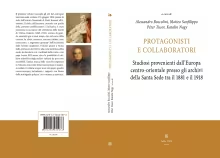
    As part of the Fraknói Centenary, a major international event took place on 6 June 2024 at the headquarters of the Istituto Nazionale di Studi Romani (INSRI) on the Aventine Hill, in the immediate vicinity of the Palace of the Sovereign Military Order of Malta. At the scholarly conference entitled Protagonisti e Collaboratori – Studiosi provenienti dall’Europa centro-orientale presso gli archivi della Santa Sede tra il 1881 e il 1918 (“Protagonists and Collaborators – Scholars from Central and Eastern Europe in the Archives of the Holy See between 1881 and 1918”), alongside members of the Fraknói Research Group, Italian, Austrian, Czech, Polish, and Croatian researchers also delivered papers.

    The conference proceedings, published under the title Protagonisti e collaboratori. Studiosi provenienti dall'Europa centro-orientale presso gli archivi della Santa Sede tra il 1881 e il 1918 , are now appearing as the second volume of the Storia d’Ungheria series (Viterbo, Edizioni Sette Città).

    This work is the result of scholarly cooperation between the Fraknói Research Group, the Gyula Moravcsik Institute / Collegium Professorum Hungarorum, the Istituto Nazionale di Studi Romani (INSR), and the CeSPoM research center of the Università della Tuscia.


    4379
  • 2025. September 4.

    The public defense of the doctoral dissertation of Róbert Oláh, assistant research fellow of the Vilmos Fraknói Vatican Historical Research Group, was held on 4 September at the Pázmány Péter Catholic University. Prepared under the supervision of Péter Tusor and Gábor Nemes, his PhD dissertation, The Ecclesiastical Middle Class in Early Modern Győr: A Prosopographical Analysis of the Cathedral Chapter of Győr, 1658–1783, was reviewed by Dr. habil. Barnabás Guitman, PhD, Assistant Professor (Institute of History, Faculty of Humanities and Social Sciences, Pázmány Péter Catholic University) and Prof. Dr. István Fazekas, DSc, Professor (Institute of History, Faculty of Humanities, Eötvös Loránd University). The chairman of the doctoral committee was Prof. Dr. László Szelestei Nagy, Professor Emeritus and former Dean of the Faculty of Humanities at Pázmány Péter Catholic University. The members of the committee included senior archivists István Hermann and György Rácz, as well as Kornél Szovák, Director of the Moravcsik Institute, who – as is well known – also serve as professors of Pázmány University.

    The dissertation was awarded the distinction of summa cum laude (97%). An expanded version of the dissertation is expected to be published in book form in the series Collectanea Studiorum et Textuum (CST).

    The successful defense, held before a large audience, marked another significant event in the ongoing program of nurturing young scholars within the Fraknói Research Group. The young fellows of the CPH Hungarica–Vaticana team were also present on the occasion.

    The doctoral dissertation can be read here.


    4527
  • 2025. August 19.

    Under the title “We have not come to celebrate, but to pay the tribute of reverence …”, an academic conference on the Battle of Mohács and its age was convened by the Municipality of Székesfehérvár, the Institute and Museum of Military History, and János Kodolányi University within the framework of the Royal Days of Székesfehérvár, held on 18–19 August 2025. Bringing together many of the foremost figures in Mohács scholarship, the conference represented a landmark contribution to ongoing research into one of the pivotal moments of Central European history. The Fraknói Research Group also participated, presenting under the chairmanship of Péter Tusor a dedicated panel on the ecclesiastical dimensions of Mohács on the morning of the second day. (The full programme of the conference is available here.)

    The first paper of the session was delivered by Tamás Kruppa, Hungarian–Ottoman Peace Negotiations and Peace Initiatives before Mohács (presentation available here). Making use of both well-known and previously overlooked Venetian diplomatic reports, he provided a nuanced survey of the diplomatic interactions between the court of Buda and Istanbul from 1500 to 1526—offering fresh perspectives on late medieval diplomacy at the intersection of East and West.

    In his lecture, Tamás Fedeles examined The Role of Ecclesiastical Army in the Hungarian–Ottoman Wars of the 1520s (see presentation here). He demonstrated how, in the Jagiellonian era, the ever-growing Ottoman menace along the southern frontier prompted substantial innovations in the organisation of national defence, inevitably shaping the involvement of the clergy. The decisive turning point, however, came with the decree of King Wladislas II in 1498, whose 20th article required ecclesiastical prelates and institutions to provide a total of 6,900 armed men. Fedeles illustrated through numerous case studies how ecclesiastical contingents participated in the campaign for the recapture of Belgrade (1521), in smaller Hungarian victories in Syrmia (1523), and, most fatefully, in the Battle of Mohács (1526). At Mohács, roughly 20% of the entire Hungarian army consisted of ecclesiastical troops—an impressive proportion underscored by the fact that half of Hungary’s high clergy perished in the encounter, including two archbishops and five bishops. These findings reinforce the conclusion that ecclesiastical military forces were integral to the anti-Ottoman struggles of the Jagiellonian period, not merely marginal auxiliaries.

    Gábor Nemes, in his paper The Papacy’s Struggles against the Ottomans before 1526, provided a broader transnational perspective, situating Mohács within the evolving history of papal diplomacy and crusading ideology. He analysed the papacy’s seminal role in the emergence of the crusading ideal and the transformations it underwent in the Renaissance era, particularly under the impact of humanism. From the 1440s onwards, and especially after the fall of Constantinople in 1453, the struggle against the Ottomans became a primary objective of papal diplomacy. Nemes highlighted the crucial roles played in Hungary by cardinal legates such as Giuliano Cesarini, Juan de Carvajal, Pietro Isvalies (1500–1503), Tommaso de Vio (1523–1524), and Lorenzo Campeggi (1524–1525), whose interventions reveal the international embeddedness of Hungary’s anti-Ottoman wars.

    Advancing chronologically, Viktor Kanász presented Money, Horses, Arms. Papal Assistance in the Anti-Ottoman Struggles in the Decades after Mohács (presentation downloadable here). His paper examined the multifaceted forms of papal assistance—diplomatic, financial, and military—in the aftermath of Mohács. He stressed that such efforts should be seen as a natural continuation of medieval precedents, even though papal objectives ultimately went unfulfilled, due largely to the altered geopolitical realities of both Europe and the papacy. Yet these endeavours paved the way for later developments: half a century later in Gianfrancesco Aldobrandini’s campaigns, and ultimately, in the late seventeenth century, in the decisive achievements of the Holy League under Pope Innocent XI, which culminated in the liberation of the Kingdom of Hungary.

    In his lecture The Memory of Archbishop Pál Tomori in the Archdiocese of Kalocsa (from the Early Twentieth Century to the Present), György Sági offered a case study in ecclesiastical memory politics. He traced how Tomori, who had fallen heroically at Mohács, was remembered by his successors over the course of more than a century, often held up as a model of steadfastness. From church commemorations to secular memorial initiatives, Sági demonstrated how the figure of Tomori remained a reference point for local identity and collective remembrance. (presentation available here)

    The concluding session, presented by Viktor Kanász and Katalin Nagy, addressed In the Shadow of Burgio. The Papal Nuncios in Budapest and the Memory of Mohács (presentation available here). Their study analysed the role of papal nuncios in the commemorations of the 1920s and 1930s, situating them within the wider field of transnational memory studies. At the centenary commemoration in 1926, Nuncio Cesare Orsenigo, acting as patron, received considerable public attention, yet deliberately distanced himself from the political dimension of the event. His successor, Angelo Rotta, likewise declined to participate in subsequent commemorations, citing other commitments. This deliberate reserve reflected the nuncios’ awareness that the commemorations were largely organised by political actors and offered little in the way of genuine diplomatic or pastoral opportunities. Their involvement thus remained passive, largely representative, and emblematic of the papacy’s cautious diplomacy in interwar Central Europe.

    Beyond its presence at this conference, the Fraknói Research Group maintains multiple ties to Mohács-related scholarship. In September 2025, further results will be presented at a conference in Sárvár (see here), while under the leadership of Tamás Fedeles, the compilation of the Bishops’ Lexicon of the Jagiellonian Period continues (see here for earlier reports). Both initiatives testify to the Group’s role as a reference point in ecclesiastical historiography and as an active contributor to international scholarly exchange.


    Full videos of the presentations are in preparation.
     

    4501
  • 2025. August 11.

    On 11 August 2025, precisely on the 125th anniversary of his death, a commemorative session honouring Bishop Fülöp Steiner (1839–1900) was convened at the episcopal palace in Székesfehérvár. The event was formally opened by Bishop Antal Spányi of Székesfehérvár, after which Gergely Mózessy, Director of the Diocesan Archives, delivered a lecture on Steiner’s life and his leadership of the diocese, highlighting recent findings that substantially advance scholarly understanding of his episcopal activity.

    The historian János Rada then presented the Biographical Lexicon of the Dioceses and Bishops of Hungary (1804–1918) (Magyarország egyházmegyéi és püspökei (1804–1918)), published in 2025. He emphasised its status as a landmark scholarly work, underlining its role as a long-awaited and internationally significant contribution that fills a major gap in ecclesiastical historiography. He praised the editors and authors for their years of persistent scholarly endeavour. Thanks to this monumental volume, the lives and works of Fülöp Steiner and the other bishops of Székesfehérvár can now be examined within a broader historical framework and on firmer scholarly foundations, offering new insights not only to the scholarly community but also to the wider public. Concluding the book presentation, Péter Tusor—Hungarian lead coordinator of the decade-long research and co-editor of the lexicon—gave a concise reflection on the complexity of the project, the internal dynamics of the research process, and the national-strategic significance of the German edition published in Berlin in 2020. The event also saw the participation of the new young fellows of the Fraknói Research Group, who, under the direction of Scientific Secretary György Sági, contributed to the project through the preparation of the index.

    The commemoration concluded with a solemn Mass offered in memory of Bishop Fülöp Steiner, followed by a brief act of remembrance at his tomb in the cathedral.

    The Budapest presentation of the Bishops' Lexicon 1804–1918 will take place on 8 October 2025 in the ceremonial hall of the Central Seminary.


    4534
  • 2025. June 29.

    The scholarly legacy of Vilmos Fraknói in Rome is today embodied by the Collectanea Vaticana Hungariae—the series that revived the Monumenta Vaticana Hungariae in 2002/2004. These volumes, which present the results of ongoing fundamental research, are published under the imprint “Budapest–Rome.” From the printing press in Pest, they are sent directly to Rome, where the CVH has had a home for over two decades in several prominent academic collections, including the Accademia dei Lincei (Palazzo Corsini), the Pontifical Gregorian University, the Pontifical University of the Holy Cross, the libraries of the German and Austrian historical institutes in Rome, as well as the Pontifical Hungarian Institute and the Saint Stephen House.

    At both the Vatican Apostolic Library and the Vatican Apostolic Archives, CVH volumes are placed on open-access shelves—alongside the original Monumenta Vaticana edited by Fraknói himself (see photos below for the latter). The most significant works are often introduced to the international scholarly community through dedicated symposia. Most recently, in 2022, one such presentation took place at the Deutsches Historisches Institut in Rom.

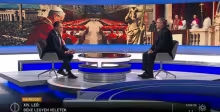
    The regular and default venue for the Roman presentation of each new volume is the studio of Vatican Radio. Thanks to the attentive and generous collaboration of the Hungarian editorial department—particularly Father László Vértesaljai—news of the Fraknói Research Group’s ongoing Vatican-based scholarship is broadcast urbi et orbi, directly from within the Vatican.

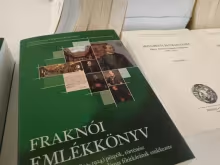
    In keeping with this tradition, Péter Tusor and Gábor Nemes gave an interview to Vatican Radio during the 2025 Institute Week. In conversation with Father Vértesaljai, they discussed the Vatican research of Vilmos Fraknói and his contemporaries, prompted by the publication of the Fraknói Memorial Volume (CVH I/24, available for download here), and reflected on the life and legacy of the renowned Bishop of Arbe.

    Péter Tusor’s commentary on Fraknói, his centenary, and the commemorative volume can be heard from 12:10 [here], while Gábor Nemes's remarks, focusing on the Vatican research of József Lukcsics, begin at 12:00 [here].

    Earlier that month, on June 7, Miklós Jávor—external research fellow of the Fraknói Research Group—appeared on Hungary’s national television channel M1, where he presented the history of the Csíksomlyó pilgrimage (beginning at 17:50 [here]).


    4209
  • 2025. June 16.

    On June 12, 2025, the concluding symposium of the multi-year international project titled "Curia romana e nazioni europee" took place in the Eternal City, within the prestigious halls of the Istituto Nazionale di Studi Romani (the same venue where the Research Group had organized a conference last year in commemoration of the centenary of Vilmos Fraknói). Following the welcome address by Gaetano Platania, President of the INSR, renowned historians evaluated the results of the research carried out with the active involvement of the Research Group. Michaela Valenti (Sapienza), Massimo Giannini (University of Teramo), and Fr. Silvano Giordano, OCD (Gregorian University), under the chairmanship of Fr. Roberto Regoli (Gregorian University), assessed the significance of the research not only within the European context, but – through transatlantic relations – within universal historiography as well.

    The project series began in 2018 with an international conference held at the headquarters of the Hungarian Academy of Sciences in Budapest. The structured findings of Italian, Spanish, French, German, Austrian, English, Portuguese, Canadian, Brazilian and Hungarian scholars have been published in volumes in English, Italian and French.

    • 1. Gli agenti presso la Santa Sede delle comunità e degli Stati stranieri, I. Secoli XV-XVIII e II. Secoli XVIII-XX, a cura di Matteo Sanfilippo e Péter Tusor, Sette Città 2020 e 2021.
    • 2. I Barberini e l’Europa, a cura di Péter Tusor e Alessandro Boccolini, Sette Città 2022
    • 3. I collegi per stranieri a/e Roma nell’età moderna: I. Cinque-Settecento, a cura di Alessandro Boccolini, Matteo Sanfilippo e Péter Tusor, Sette Città 2023; II. 1750- 1915, a cura di Alessandro Boccolini, Philippe Roy-Lysencourt, Matteo Sanfilippo e Péter Tusor, Sette Città 2024; III. Dalla Grande Guerra a oggi, a cura di Alessandro Boccolini, Philippe Roy-Lysencourt, Matteo Sanfilippo e Péter Tusor, Sette Città 2025.

     The evaluative analyses delivered on the Aventine Hill before a large audience can be listened to [here]. The volumes are available for download [here].

    * * *

    The symposium held at the INSR represented a particularly significant milestone in the overarching "master plan" of the Budapest-based Fraknói Research Group. According to this concept, the core archival research takes place in the Vatican, the extended process of scholarly analysis is conducted in Hungary, and the results are then presented once again in Rome – within a knowledgeable, prestigious international academic forum. Such was the case, for example, in 2018 at the Pontificia Università della Santa Croce and in 2022 at the German Historical Institute (DHI). Thanks to this method, the Fraknói Research Group has effectively been continuing Vilmos Fraknói’s scholarly work in Rome and representing his legacy for over two decades, since the launch of Collectanea Vaticana Hungariae in 2004. In doing so, it virtually fills the void left by the absence of a systematic, research-focused Hungarian Historical Institute in Rome that would investigate the Holy See’s collections in a scholarly capacity.

    During the joint Roman research week of the Fraknói Research Group between June 8 and June 15, 2025, this „Historical Institute of Hungary in Rome” (RMTI) was effectively brought to life for the third consecutive time, following the similar programs of 2023 and 2024. The members, setting out each day from the Szent István House (Casa di Santo Stefano), engaged in primary research throughout the full opening hours of the Vatican Apostolic Archive, the Vatican Apostolic Library, the Archivio di Stato di Roma, the Archivio Storico Capitolino and the Historical Archives of the Secretariat of State. In their free time, they distributed copies of the Research Group’s latest publications – including the Fraknói Memorial Book and the Lexicon of Hungarian Bishops – to major Roman libraries, such as the Vatican Library, the Gregoriana, Santacroce, Corsini, and the German and Austrian Institutes. Meanwhile, they immersed themselves in the inexhaustible sights and artistic riches of the Eternal City, and in the evenings shared their scholarly and personal experiences over common dinners.

    Due to the closure of the Vatican archives on June 9, 2025 – on account of the Vatican staff's Holy Year Jubilee – the Fraknói Research Group visited only Italian state archives in the morning. In the afternoon, they traveled to nearby Frascati, where they visited the famed Villa Aldobrandini, whose private archive holds the canonical investigation protocol of Cardinal Péter Pázmány. The planning meeting for the 2025/26 academic year also took place there.

    On the morning of Wednesday, June 12, 2025, the members of the Research Group, engaging in meaningful and authentic academic diplomacy, paid a courtesy visit to the new Prefect of the Vatican Apostolic Archive, Fr. Rocco Ronzani, O.S.A., to whom they presented several recent and reissued volumes of the Collectanea Vaticana Hungariae. (The speech by Research Group leader Péter Tusor can be read [here].)

    The research activities and academic program were rounded out by excursions to historic sites around Rome – Genazzano, Fossanova, Terracina, and Ariccia – as well as a friendly football match against the Italian staff of the Szent István House, dubbed the “primo Fraknói-calcio”, appropriately held during the Jubilee Week for athletes.

    Kornél Szovák, Director of the Moravcsik Institute and Secretary of the CVH Editorial Board established in 2002, as well as two former students of Pázmány Péter Catholic University, now historians, who were newly welcomed as honorary members were also participants of the Fraknói Research Group's 'RMTI Week'.

    4197
  • 2025. May 12.

    The public defense of Tamás Kruppa’s doctoral dissertation for the title of Doctor of the Hungarian Academy of Sciences (DSc), entitled From the Jagiellonians to the Szapolyais: Two Decades from the History of the Kingdom of Hungary (1519–1541), was held on 12 May 2025 in the Ceremonial Hall of the Hungarian Academy of Sciences, located at 13 Teréz Boulevard, Budapest. The official opponents were Pál Ács, Tibor Neumann, and István Tringli.

    Tamás Kruppa has been closely involved with the Fraknói Research Group since 2017. As a senior research fellow, his work focuses on the relations between Transylvania and the Holy See during the Báthory era, as well as on the systematic exploration of Italian diplomatic sources from the first half of the sixteenth century, with particular emphasis on Hungarian–Papal relations under the Jagiellonian and Szapolyai dynasties. In addition to Vatican archives, he also conducts thorough research on relevant Venetian diplomatic reports.

    He contributes to training the next generation of scholars by sharing his research experience in Rome and by conducting early modern Italian palaeography workshops.

    In the history of the Fraknói Research Group, this is the third academic DSc title awarded to a member, following those of Péter Tusor (2014) and Tamás Fedeles (2022).


    4154
  • 2025. June 3.

    Organized by the Fraknói Research Group and the Gyula Moravcsik Institute of the HUN-REN Research Centre for the Humanities, the Fraknói Summer Academy was held for the eleventh time between 29 and 31 May 2025. After being held in Nagyvárad last year, this year’s event returned once again to Budaörs and, for the first time, was also hosted in Budapest.

    On the afternoon of the first day, the program began at the Central Seminary in Budapest, following the opening addresses by Péter Tusor, head of the research group, and Nándor Birher, Dean of the Faculty of Humanities at Pázmány Péter Catholic University. This year, the Academy focused on Transylvanian (ecclesiastical) history and historical research.

    In his keynote lecture, historian Zsolt Tamási examined the topic of the planned Hungarian national synod of 1848.
    The program continued with another panel discussion enriching the history of the Fraknói Academies. This time, Péter Tusor interviewed Mons. József Marton, emeritus Provost of Gyulafehérvár, about his family background, academic studies, vocation to the priesthood, and his work as a teacher and researcher. The largely Hungarian audience from Hungary gained insight into the difficulties and restrictions faced by the Hungarian Catholic community in Romania under the communist regime. The emeritus provost also shared personal memories of the late Transylvanian bishops (Archbishops of Gyulafehérvár), Áron Márton, Antal Jakab, and Lajos Bálint.

    The event continued the next morning, on 30 May in Budaörs. Acting as curator, Péter Tusor once again welcomed the participants and opened the academic conference. Before the scholarly presentations began, Zsolt Bogdándi, director of the Zsigmond Jakó Research Institute of the Transylvanian Museum Society (Erdélyi Múzeum Egyesület a.k.a. EME), presented the institute’s work, outlining the source-oriented, fundamental research conducted by its scholars.

    Following this, researchers of the Transylvanian Museum Society gave lectures, including Géza Hegyi, András W. Kovács, Anikó Szász, Tamás Fejér, Zsolt Bogdándi, Emőke Gáfi, László Pakó, Csaba Izsán, and Kinga Papp. The evening concluded with a roundtable discussion focused on the current state of Hungarian historiography in Transylvania.
    The academic program closed with a concluding address by Kornél Szovák, Director of the Moravcsik Institute and co-curator of the Academy.

    On 31 May, participants took part in a hike from Budaörs to the shrine church of Makkosmária.


    PROGRAM

    GALÉRIÁK: 1. nap, 2. nap, 3. nap

    VIDEÓK: feltöltés alatt

    EME

    4153
  • 2025. May 19.

    Between May 16 and 18, 2025, the Pongrácz Saint Stephen History Competition was held for the second time in Gyulafehérvár and Alvinc. Viktor Kanász, research fellow of the Fraknói Research Group, participated as a jury member alongside Teréz Oborni, Rev. Botond Bátor (Pauline friar), Viktor Dávid Körősi (chief consul), art historian Enikő Hegedűs, and archdiocesan chief school inspector Rev. László Gál.

    The theme of the competition was the life and times of Cardinal George Martinuzzi (Fráter György). Participants visited the well-known site of the Bishop of Várad's death—the now-ruined castle of Alvinc—where Teréz Oborni and Viktor Kanász explained the causes and consequences of the murder committed on December 17, 1551, as well as the details of the lengthy investigation conducted by the Holy See.

    Kanász also pointed out that the primary sources for this case are preserved in the Vatican Apostolic Archive, while copies of some of the nuncial documents can be found, among other places, in the Batthyaneum Library in Gyulafehérvár.

    The awards ceremony took place in the St. Michael's Cathedral of Gyulafehérvár, where, following the Holy Mass, Teréz Oborni and Viktor Kanász offered their assessments of the participants’ performances.


    (Photos: Zsolt Geréd/Foto Marco, Adrian Dicu and Zsófia Kanász-Bellovics)

    4177
  • 2025. May 8.

    In recent weeks, the papal conclave has drawn heightened public attention. Alongside this interest, a multitude of self-proclaimed “experts” have emerged, spreading numerous inaccuracies and half-truths across various platforms. As the Fraknói Research Group considers it essential—not only to conduct fundamental scholarly research but also to present historical knowledge and recent findings in an accurate and accessible manner—its members accepted several invitations to share their insights on the conclave through both public and commercial media outlets.

    On May 8, Péter Tusor appeared on Kossuth Radio’s Good Morning, Hungary program to present the modern and contemporary history of papal conclaves, as well as reflections related to the current one. The previous day, May 7, Gábor Nemes offered live commentary on the opening of the conclave on HírTV. Earlier, on April 24, Viktor Kanász discussed the historical background of papal elections on Retro Radio.

    Following the election, further interviews were given on May 10: Péter Tusor appeared on M1, and Viktor Kanász returned to Retro Radio to comment on the identity of the new pope, the choice of papal name, his first gestures, and their historical significance.

    In addition, György Sági provided an overview of the background leading up to the present conclave in an article published on Újkor.hu 

    Péter Tusor’s radio interview can be listened to here (from 7:20), and his TV interview here.
    Gábor Nemes’s interview is available here.
    Viktor Kanász’s first interview can be heard here (from 36:00), and his second one here (also from 36:00).


    4123
  • 2025. May 11.

    The Hungarian Medieval Studies Research Group, together with the National Archives of Hungary and the Archives of Pest County, organized the Medieval Book Fair on May 9 this year. As per tradition, the Fraknói Research Group participated in the event, where visitors had the opportunity to become acquainted with its latest publications, including the Fraknói Memorial Volume and The Centuries of the Archdiocese of Kalocsa. Among the new releases, the fair was the first occasion where attendees could hold in their hands the freshly printed source publication The Medieval Account Book of the Cathedral Chapter of Győr (1495–1528), issued jointly by the Diocesan Collection Centre of Győr and the Research Group.


    4147
  • 2025. April 22.

    On April 18, Good Friday, Regényes történelem ("Romantic History") on Kossuth Radio featured a special example of late medieval Italian pilgrimages, presented by Viktor Kanász (the interview can be listened to here). The research fellow of the Fraknói Research Group discussed the 1525 journey of László Kanizsai to Rome and Loreto, explaining how the nobleman prepared for the pilgrimage, who accompanied him, which route he might have taken, and why he stopped in Loreto. He gave detailed insight into how the Pope knighted Kanizsai in the Vatican Palace, how he returned home via Venice, what might have motivated the journey, and how all of this fits into the broader pattern of Hungarian pilgrimages to Rome at the time. In this context, he highlighted that 1525—like 2025—was a Holy Year celebrated by the Church. The interview also explored what written sources allow us to reconstruct such pilgrimages.

    A week earlier, Zalai Hírlap recorded a podcast with him (available here), in which the question of pilgrimage—also appearing in novels—was discussed in relation to the literary memory of the Kanizsai family. The study that formed the basis of this discussion is available here, and the 500th anniversary of the knighting was commemorated on Újkor.hu .

    Previous interviews with members of the Fraknói Research Group can be found here.


    4108
  • 2025. April 8.

    Following the presentation in Kalocsa, on April 8, 2025, the Párbeszéd Háza (House of Dialogue) hosted the launch of the volume A kalocsai érsekség évszázadai (Centuries of the Archdiocese of Kalocsa), which contains the written versions of the lectures delivered at the 9th Fraknói Summer Academy. Published as Volume 6 of the series Collectanea Studiorum et Textuum I, the collection of studies was introduced by Rev. Tamás Véghseő. After presenting the previous volumes in the series and their relevance to diocesan history, Véghseő proceeded to review the individual studies included in the volume. He drew particular attention to the creative arrangement and titling of the connecting chapters, which provide coherence to the collection. He emphasized that even researchers in church history who have no specific ties to Kalocsa may find not only knowledge but also inspiration in these pages. He concluded his remarks by raising several topics worthy of further reflection.

    Following this, a roundtable discussion was held with the participation of Gábor Bánkuti, Rev. Máté Gárdonyi, Rev. Edvárd Kajtár, Gábor Kiss, Andor Lakatos, and Gergely Mózessy, in connection with a volume published by the Archdiocesan Archives of Kalocsa in 2024: A Kalocsai Főegyházmegye plébániáinak jelentése a II. Vatikáni Zsinat utáni liturgikus reformok végrehajtásáról (1967) (Reports of the Parishes of the Archdiocese of Kalocsa on the Implementation of the Liturgical Reforms Following the Second Vatican Council (1967), edited by Gábor Kiss and Andor Lakatos (Kalocsa, 2024).

    Meghívó

    4106
  • 2025. April 7.

    Tamás Fedeles, scientific advisor and co-leader of the Research Group, gave a lecture in Győr as part of the Church History Evenings – a public lecture series organized by the Diocesan Collection Center of Győr, the János Brenner College of Theology, and the Church History Section of the Hungarian Historical Society. The lecture, titled Saints, Indulgences, and Pilgrimage in the Late Middle Ages, provided the large audience with an opportunity to learn about the theological background of indulgences and pilgrimage, the motivations behind pilgrimages, as well as the most important medieval pilgrimage sites in both Europe and Hungary.


    4107
  • 2025. March 21.

    On March 21, 2025, a dual book presentation was held in Kalocsa at the Astriceum Archiepiscopal Museum. The event was organized by the Archdiocesan Archives of Kalocsa in collaboration with the Fraknói Research Group.

    The attendees were welcomed by Balázs Bábel, Archbishop of Kalocsa-Kecskemét. In his opening speech, he emphasized the particular significance of presenting these volumes in the archiepiscopal see, given that their content primarily pertains to the history of the archdiocese. As such, the information published in them is of heightened relevance to the present local community.

    In his remarks, the prelate recalled the IX. Fraknói Summer Academyi, held in Kalocsa in August 2023, in which he had also participated as part of a panel discussion led by Péter Tusor. The lectures delivered at that event form the basis of the book Centuries of the Archdiocese of Kalocsa (A kalocsai érsekség évszázadai) , edited by Viktor Kanász and György Sági, which was the first volume presented on this occasion. The archbishop specifically noted that one of the editors, György Sági, also contributed a study to the book as an author.

    Regarding the second volume presented—a source publication entitled Reports of the Parishes of the Archdiocese of Kalocsa on the Implementation of the Liturgical Reforms Following the Second Vatican Council (1967), edited by Gábor Kiss and Andor Lakatos—the archbishop shared a personal reflection. He recalled how he had experienced the transition to the vernacular liturgy at the time. He spoke of his enthusiasm for attending Masses celebrated by priests who had begun practicing this change in Hungarian. He also touched upon the resistance to the introduction of versus populum altars, which was particularly evident among the older clergy.

    Following Archbishop Bábel's introductory remarks, historian Miklós Jávor, an external research fellow of the Fraknói Research Group, took the floor. He introduced volume I/6 of the Collectanea Studiorum et Textuum series. After making general comments on the structural division of the volume, he provided a detailed discussion of the individual studies, occasionally pointing to possible directions for further research. His presentation offered the audience a comprehensive picture of the ecclesiastical, general historical, educational, and cultural-historical complexity of the Archdiocese of Kalocsa.

    The task of presenting the source publication was undertaken by József Szakály, titular provost and parish priest-dean of Topolya, thus ensuring the representation of the historical Archdiocese of Kalocsa-Bács’s region that now belongs to Serbia. In his lecture as a liturgical expert, he addressed the multilingualism of the southern region, referring to a speech given by the late Bishop Mátyás Zvekanovity of Szabadka (Subotica, SRB) at the Second Vatican Council, in which he argued in favor of the exclusive use of Latin. His reasoning was that transitioning to vernacular languages would create confusion in his diocese. Eventually, the issue was resolved by holding multilingual Masses and later increasing the number of Masses. The parish priest of Topolya also reflected on generational differences among clergy, highlighting how various groups responded to the liturgical reforms. He illustrated his points with examples and practices of priests, some of whom he had personally known.

    At the conclusion of the book presentation, Archbishop Bábel expressed his gratitude to the attendees for their presence and to the experts for their insightful presentations on the volumes.


    Invitation

    Magyar Kurír

    kalohirek.hu

    4110
  • 2025. February 26.

    The Fraknói Centennial series of events, which commenced on February 27, 2024, and lasted for a year, concluded on February 26, 2025, on the eve of the birthday of Vilmos Fraknói (1843–1924), former Secretary General of the Hungarian Academy of Sciences, at the Central Seminary. This institution, within whose walls Fraknói, as a seminarian, decided to pursue a career as a historian alongside the priesthood, was also where he composed his first works and academic papers between 1858 and 1864.

    On the centenary of his death, workshops (see here and here) and research seminars (see here), the Fraknói Academy in Nagyvárad, the Rome conference, the wreath-laying at the Lateran, the renovation of his tomb, and the commemoration on November 19 all served to recall the memory of the Research Group's namesake. His scholarly contributions, priestly vocation, and personal legacy are permanently commemorated in the Fraknói Memorial Book.

    The volume convincingly demonstrates that Fraknói, both as a scholar and a prelate, was at least as significant a figure in Hungarian science and Catholicism as his mentor, patron, and friend Arnold Ipolyi. His patriotism and progressivism, rooted in historicism, place him alongside his close friend Ottokár Prohászka. However, while Ipolyi's legacy and veneration were preserved through ethnography and art history, and Prohászka's memory was steadfastly maintained by the Diocese of Székesfehérvár, Fraknói Vilmos's remembrance gradually faded in comparison to theirs and his historical significance. On the centenary of his death, the Research Group named after him, functioning as a research group at Pázmány Péter Catholic University in Budapest, sought to change this.

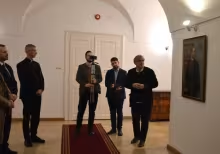
    Beyond the scholarly volume, a new artistic creation also preserves the memory of the scholar-prelate who passed away a century ago. As a key moment of the closing event on February 26, 2025, the portrait titled "Vilmos Fraknói, Secretary General of the Hungarian Academy of Sciences and Founder of the Monumenta Vaticana Hungariae," painted by artist Gábor Bükösdi on commission from Péter Tusor for the centenary, was placed on the first-floor corridor of the Central Seminary. Fraknói's portrait was accorded a prominent place near the entrance of the institution's ceremonial hall, alongside the paintings of former seminary rector Arnold Ipolyi, former student János Csernoch, Prohászka, and others, as well as the statue of the eternal historical figure, Péter Pázmány. During the portrait unveiling, brief speeches were delivered by Péter Tusor, Bishop-Rector Levente Balázs Martos, Gábor Bükösdi, and Tamás Fedeles.
     

    Prior to this, during the 12th Fraknói Workshop Lecture held in Room 10 of the Seminary, Péter Tusor presented his latest historiographical findings in a lecture titled "Vilmos Fraknói and the Episcopate: On the Foundation History of the Roman Historical Institute (1910–1913)." At the end of his presentation, he announced that, in coordination with the conclusion of the Fraknói Centennial, the volume of the Bishop's Lexicon (1804–1918) had been published (948 pages). Its dedication is addressed to Vilmos Fraknói, who never formally became a member of the modern Hungarian hierarchy but devoted his entire life to Hungarian historical research, particularly in the Vatican. Through this volume, historiography now offers him due recognition, granting him a virtual place among the most distinguished: József Lonovics, Lajos Haynald, Gusztáv Mailáth, Ágoston Fischer-Colbrie, Ottokár Prohászka, Gyula Glattfelder, and others.

    The concluding series of events was brought to a close with a Pontifical Mass celebrated by S.E.R. Levente Balázs Martos in memory of Vilmos Fraknói at the University Church, where his solemn Requiem Mass was originally celebrated. The memorial Mass evoked the milieu of the 19th century through organ works by Franz Liszt (1811–1886) and César Franck (1822–1890), including the Offertory from the Hungarian Coronation Mass and "Prélude, Fugue et Variation in B minor (Op. 18).
     

    Invitation

    PPT (12th Fraknói Seminar Lecture)

    Magyar Kurír

    Videos below!

    4111
  • 2025. February 26.

    Hungary’s Dioceses and Bishops (1804–1918). Institutional History and Biographical Lexicon I–IV, eds. Zsófia Szirtes, Péter Tusor, Rupert Klieber, Budapest 2025 (xxvi+832 pp. + [90] pp. annotated black-and-white and color image supplement).
     

    The first phase of the "Bischofslexikon 1804–1918," a mega-project of the Fraknói Research Group initiated within the framework of the MTA Lendület pProgram and spanning multiple funding cycles, was completed at Pentecost 2020. The results of this extensive international research collaboration are presented in an impressive volume published by Duncker & Humblot in Berlin: Die Bischöfe der Donuaumonarchie 1804 bis 1918. Ein amtsbiographisches Lexikon, edited by Rupert Klieber, Volume I: Die röm.-kath. Kirchenprovinzen Gran, Kalocsa, Erlau im Königreich Ungarn, with contributions from Péter Tusor, Duncker & Humblot, Berlin 2020 (xviii + 661 pages). Further details on the research’s international dimension are available here, along with presentations in Budapest, Rome, and Vienna. The research focus of the Fraknói Research Group is diocesan history, which, in studying the "long 19th century," also incorporates fundamental Vatican research findings. The project itself originates in Rome, whether considering the role of its initiator, Campo Santo Teutonico rector Erwin Gatz († 2011), or the Vatican archival roots of the decade-and-a-half-long collaboration with chief editor Rupert Klieber.

    The second phase, i.e., the Hungarian-language edition (Püspöklexikon 1804–1918), was largely completed by Christmas 2023. This Hungarian lexicon is a revised and expanded edition. While in the case of the German lexicon, the ultima manus belonged to the Viennese chief editor, Professor Rupert Klieber, in the present edition, it is the individual article authors who hold that final authority. To metaphorically reflect the milieu of the Dual Monarchy, one might say that while the German version 1.0 was shaped by Vienna, the Hungarian 2.0 edition was shaped by Budapest—following mutual professional consultations. The research project and its results can only be fully evaluated and understood with reference to the Hungarian edition. During the editing process, Professor Klieber, with the assistance of his colleagues, undertook an enormous effort to standardize, revise, and expand the lexicon entries with new archival and printed sources, as well as German scholarly data. In the vast majority of cases, Hungarian authors and editors continued their work using the materials developed by Klieber, with texts translated back from German by Zsófia Szirtes. The results of Klieber’s editorial work were generally retained, though in some biographical entries, the original perspective of the authors prevailed more strongly. In the Hungarian edition, the authors are solely credited with their respective entries. Regarding diocesan descriptions, Klieber’s clearly delineated statistical analyses are directly cited from the German edition. This two-stage research concept evolved interactively between Vienna and Budapest over the course of what has become an almost longue durée project, reaching its final form in 2018–2019. The necessity of updating the lexicon entries before the Hungarian edition was largely dictated by the extended time span of the research itself. (Details on the textual work are provided in an introduction introduction by Zsófia Szirtes, the chief editor of the Hungarian edition.) The bibliographic data reflect the state of research as of 2023. Every effort was made to correct the inevitable errors of the first German edition, a common challenge in such large-scale scholarly undertakings. (The detailed Errata & Corrigenda for the German edition will be made available online following the publication of the corrected Hungarian edition.)

    For the articles authored by Slovak scholars on Upper Hungarian dioceses, we have followed Professor Klieber’s recommendation to translate their German versions, limiting our intervention to data verification and bibliographic expansion. This decision was made because Slovak authors made only partial use of the—mainly older—Hungarian historiography. The critical reading of Slovak interpretations, which often diverge significantly from Hungarian historical perspectives, is left to the knowledgeable Hungarian readership, with the exception of the introductory sections for two dioceses. The professional discussions conducted through Vienna regarding our shared history, which is perceived and interpreted in almost entirely different ways by Hungarian and Slovak scholars, remain an issue yet to be addressed in detail. It is an extremely significant achievement that in 2020, the centenary of the Trianon tragedy, we succeeded in ensuring that the prestigious international volume published in Berlin—despite certain tendentious, one-sided statements—presents Hungarian history fundamentally as Hungarian history. That is, it is largely free from the regrettably frequent attempts to retroactively project the present status quo into the past or to historically justify it. Achieving this goal required numerous compromises, and in the process, we inevitably faced failures as well—such as our request regarding the historical presentation of the Dioceses of Nyitra and Besztercebánya (Nitra and Banská Bystrica). The depiction of these two dioceses in the German edition remains, to put it mildly, one-sided. (See the historiographically intriguing editorial documentation, specifically the letter sent to Vienna on March 5, 2019, point 4)

    This extensive research project has not been supported by hundreds of millions in ERC funding. Nevertheless, its significance for understanding and interpreting Central European history has been recognized and highly esteemed at the highest levels of international scholarship, from Joachim Bahlcke to Andreas Gottsmann and Thomas Winkelbauer. (Additional reviews and presentations can be found here.) Beyond the initial funding secured by Erwin Gatz, the project was realized solely through the support of the Österreichisches Wissenschaftsfonds (Austrian Science Fund) and the MTA Lendület Program, as well as a small fraction of the Fraknói Research Group’s budget from 2017–2024. In the first phase, during 2024, the Introduction by the project’s most distinguished author, † Gábor Adriányi, along with individual diocesan studies, will be published separately in electronic fascicles (e-fasciculus). These will include the complete set of episcopal biographies for each diocese. Following the structure of the German edition, bishops who served in multiple dioceses are listed under their final diocese.

    After the publication of the individual diocesan studies, the full volume will be released upon the conclusion of the Fraknói Centenary on February 26, 2025.

    The Hungarian edition is the result of teamwork by Editor-in-Chief Zsófia Szirtes, as well as Péter Tusor and Rupert Klieber, who were joined earlier by István Fazekas and András Forgó. The editorial tasks were carried out by Zita Lőrincz. Special thanks go to Margit Balogh for the diocesan introductions and her useful advice. We also thank Adrienne Tengely for the careful professional proofreading and bibliographic augmentation of the entries on Slovak authors, the rewriting of the entries on Eger and Szatmár, and Tamás Véghseő for the review and update of all (!) Greek Catholic entries. The Greek Rite Roman Catholic dioceses (V.) will be published in a separate volume. Thanks are also due to all the contributors from Székesfehérvár, Szombathely, Pécs, Szeged, Eger, and Nyíregyháza; from Gyulafehérvár, Kolozsvár, Marosvásárhely; from Upper Hungary/Slovakia, Transcarpathia; and, of course, from Vienna and Budapest. Among the authors, Gheorghe Gorun from Nagyvárad, László Bura from Szatmárnémeti, as well as Balázs Csíky, a researcher at the Fraknó Research Group, who was awarded the Bolyai Scholarship, and the late Gábor Adriányi, unfortunately, did not live to see the completion of the full Bishop Lexicon. According to Adriányi Gábor's own statement made during the proofreading phase, his introductory study to the lexicon is his final published work.

    The Bishop Lexicon 1804–1918 marks the beginning of a project with a historical dimension spanning millennia, undertaken by the Fraknói Research Group, the Moravcsik Gyula Institute, and the Collegium Professorum Hungarorum. Following the example of the German research led by Erwin Gatz, a biographical lexicon of Hungarian bishops from 1001 to 1993 will be created. The planned volumes are as follows: Bishop Lexicon 1918–1993; Bishop Lexicon 1711–1804; Bishop Lexicon 1605–1711; Bishop Lexicon 1526–1605; Bishop Lexicon 1458–1526; Bishop Lexicon 1302–1458; Bishop Lexicon 1001–1302. In preparation for the anniversary of the Battle of Mohács, the manuscript of the lexicon for the Hunyadi–Jagelló period is nearing completion. See the report by Editor-in-Chief Tamás Fedeles on this and the entire project.

    The complete volume, with an index and other apparatus, can be downloaded here.
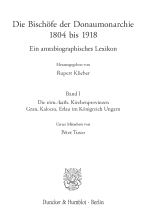
     

    4305
  • 2025. February 7.

    The November–December period was a particularly important phase in the Fraknói Research Group’s activities in 2024, which also impacted the website’s traffic. Between November 1 and December 31, 2024, more than 1,400 visitors accessed the website. The peak occurred on November 21, with over 100 users on that day alone.
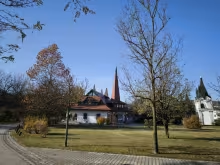
    Most visitors came from Hungary, followed by Italy, Germany, the United Kingdom, Austria, Romania, and Slovakia, where users explored news on institutumfraknoi.hu and engaged with its diverse academic and popular science content. The most visited pages included the news about the Fraknói centenary, the Fraknói Memorial Book, the international conference in Rome, and the CVH and CST series.

    Beyond direct website visits, many readers arrived via the Research Group’s social media platforms (primarily Facebook) and the Magyar Kurír website. The Fraknói Memorial Book (Fraknói Emlékkönyv), uploaded to academia.edu, also attracted significant interest.

    Another notable source of website traffic was visitors navigating from MTMT (the Hungarian Scientific Bibliography). Some arrived through the publications of the Research Group’s members, but most were directed from the Research Group’s dedicated MTMT profile pages.

    Bibliometric Data and Research Group Performance
    The scientific metrics of these profile pages, much like the previously cited website traffic statistics, deserve mention:

    MTA-PPKE Lendület Egyháztörténeti Kutatócsoport (MTA-PPKE Lendület Church History Research Group) (2012–2017)
    Total publications: 133
    Total citations: 2,408
    MTA-PPKE Fraknói Vilmos Római Történeti Kutatócsoport (MTA-PPKE Fraknói Vilmos Roman Historical Research Group) (2017–2022)
    Total publications: 518
    Total citations: 4,297
    ELKH-PPKE-PTE Fraknói Vilmos Római Történeti Kutatócsoport (ELKH-PPKE-PTE Fraknói Vilmos Roman Historical Research Group) (2022–2023)
    Total publications: 611
    Total citations: 4,453
    HUN-REN-PPKE-PTE Fraknói Vilmos Római Történeti Kutatócsoport (HUN-REN-PPKE-PTE Fraknói Vilmos Roman Historical Research Group) (2023–present)
    Total publications: 740
    Total citations: 4,521
    The data should be interpreted linearly in accordance with the different funding cycles and institutional frameworks. They indicate that, when compared to research groups established within the Lendület program and university-based TKI research groups originally founded within Lendület, the Fraknói Research Group currently holds the leading position in both key bibliometric indicators—both in absolute terms and, in most cases, proportionally over time.

    For comparison, the total number of publications of the second, third, and fourth most productive research groups—focused on medieval economic history, Greek Catholic studies, and medieval military and diplomatic history—are:

    630 (medieval economic history)
    459 (Greek Catholic studies)
    433 (medieval military and diplomatic history)
    Citation distribution shows some variation:

    2nd place: Medieval economic history research group  (1,467 citations)
    3rd place: Medieval military and diplomatic history research group (1,143 citations)
    4th place: Holy Crown research group (958 citations), which is particularly significant given that this number is based on only 312 affiliated publications.

    Conclusions and Future Outlook
    The above statistics clearly illustrate the significance of institutumfraknoi.hu, which has been systematically developed over more than a decade to provide high-quality academic content. They also highlight the effectiveness of disseminating the Fraknói Research Group’s scientific results, as well as the benefits of regular and strategic engagement with social media platforms, PPKE’s online presence, and external institutional and news portals.

    The quantitative indicators of scientific performance and reception are remarkable. However, these must be complemented by systematic, in-depth, and above all, unbiased professional evaluation of qualitative components. The peer review process is greatly facilitated by the Fraknói Research Group’s own and collaboratively produced international scientific publications, available Open Access at:
    https://institutumfraknoi.hu/kiadvanyok.


    4063
  • 2025. January 6.

    The completion of the "Bischofslexikon 1804–1918" project, spanning multiple grant cycles and culminating in the fulfillment of one of the key commitments of the 2012 Lendület Program, was achieved in the spring of 2020 by the Fraknói Research Group. The results of this extensive research, conducted through a wide-ranging collaboration within Hungary, the Carpathian Basin, and internationally, have been published in an impressive volume by the Berlin-based Duncker & Humblot publishing house: Die Bischöfe der Donaumonarchie 1804 bis 1918. Ein amtsbiographisches Lexikon, hg. von RUPERT KLIEBER, Band I: Die röm.kath. Kirchenprovinczen Gran, Kalocsa, Erlau im Königreich Ungarn, unter Mitarbeit von PÉTER TUSOR, Duncker & Humblot, Berlin 2020 (XVIII + 661 p).

    The German-language Berlin edition of the Bischofslexikon 1804–1918 is now fully available as an Open Access publication on the Fraknói Research Group's website as of January 6, 2025. See the link here!

    Work on the corrected, updated, expanded, and revised Hungarian edition of the lexicon is nearing completion. Following the release of preliminary publications containing complete biographical series by diocese, published as e-fasciculi, the editorial process for Magyarország egyházmegyéi és püspökei 1804–1918 I–IV. Intézménytörténeti és életrajzi lexikon" (Collectanea Studiorum et Textuum I/7, Budapest 2025) has begun. The material covering the ecclesiastical provinces of Esztergom, Kalocsa-Bács, and Eger, together with Pannonhalma and an introduction by Gábor Adriányi, comprises 791 printed pages (B/5 format). Additional sections include a Roman-numeral-indexed table of contents, a foreword, and various supplementary appendices. (The material on the Hungarian Greek Catholic episcopate will be published in a separate volume as Chapter V.)

    Hungarian historiography suffers from a marked lack of modern handbooks and syntheses authored domestically. The Fraknói Research Group's extensive and internationally collaborative undertaking, which has exceeded the bounds of its resources, aims to address this deficiency while also serving as an example for larger institutions equipped with more substantial resources and favorable conditions.

    The announcement includes, alongside the cover page of the Berlin German edition, several illustrations (portraits of prelates and other photographs) that do not appear in either the volume or the chapter-by-chapter publications.

    The following 1–12 images are: portraits of Sándor Bonnaz, Bishop of Csanád; János Pauer, Bishop of Székesfehérvár (in both priestly and episcopal attire); and Imre Bende, Bishop of Besztercebánya and later Nyitra. The next three photographs relate to Abbot Ipoly Fehér (his procession into Pannonhalma and then Budapest in 1892, and his departure for the 45th anniversary celebrations of Franz Joseph’s accession). This is followed by the ceremonial carriage of Primate Kolos Vaszary (1895). Lastly, there are various photographs of Count Károly Emmánuel Csáky, Bishop of Vác; Ottokár Prohászka, Bishop of Székesfehérvár; Gyula Glattfelder, Bishop of Csanád; and Antal Fetser, Bishop of Győr.


    4001