A new international series jointly published by the Fraknói Research Group, the Collegium Professorum Hungarorum, and the Gyula Moravcsik Institute has been appearing since 2024 under the title Storia d'Ungheria – History of Hungary, published by the Viterbo-based Edizioni Sette Città. Edited by Péter Tusor and Matteo Sanfilippo, the Italian–English-language series primarily aims to bring the results of original historical research on Hungarian topics conducted in the Vatican and other Italian collections directly and more widely to the international scholarly community. At the same time, its editorial board—which includes prominent Italian historians Gaetano Platania, Giovanni Pizzorusso, and Alessandro Boccolini, as well as Hungarian scholars Kornél Szovák, Tamás Fedeles, and Viktor Kanász—also intends to provide a forum for other works presenting Hungarian history.
Thanks to the publications issued in Viterbo, Hungarian historiography has, with the active involvement of the Fraknói Research Group, now been enriched by a third internationally relevant scholarly series, alongside the Collectanea Vaticana Hungariae, which publishes works based on primary Vatican sources, and its companion series, the Publikationen der Ungarischen Geschichtsforschung in Wien, established in 2009. All three series share the principle that international publication should not require the Hungarian state budget to bear substantial costs simply for the sake of a foreign publisher’s imprint, thereby increasing the already considerable profits of publishers such as Brill or Viella. The volumes are published essentially at cost and are made available in e-book format immediately; the PUGW volumes are also available Open Access after a short embargo period.
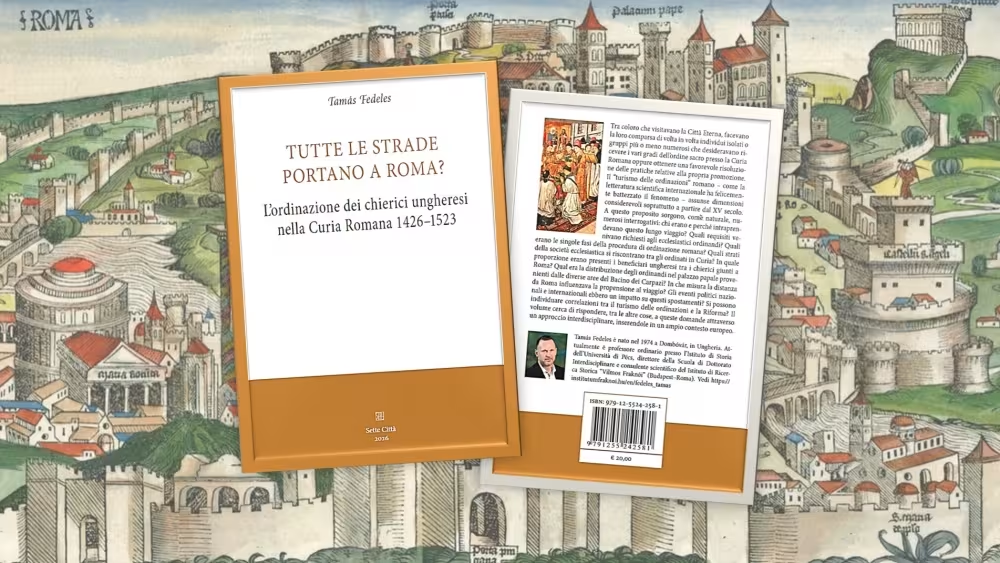
An important milestone for Storia d’Ungheria has now been reached with the publication of its third volume, the first Italian-language monograph in the series to present original research based on recently explored Vatican archival sources. The volume is the work of Tamás Fedeles, Professor at the University of Pécs and Scientific Adviser to the Fraknói Research Group, and examines the late medieval history of Hungarian clerics ordained in Rome: Tutte le strade portano a Roma? L’ordinazione dei chierici ungheresi nella Curia Romana 1426–1523 (Storia d’Ungheria 3), Viterbo, 2026.
Following the Hungarian edition, the work is now available in Italian to an international readership. It examines in detail how, among those travelling to the Eternal City, there periodically appeared individuals or larger and smaller groups who sought to receive the various degrees of Holy Orders at the Roman Curia or to obtain a favourable decision in matters concerning their ordination. This phenomenon, aptly described in international scholarship as “ordination tourism”, assumed significant proportions particularly from the fifteenth century onwards.
This raises a number of questions: Who were these people, and why did they undertake such a long journey? What requirements were imposed on those seeking ordination? What were the various stages of the Roman ordination procedure? Which social groups within the ecclesiastical hierarchy are represented among those ordained at the Curia? What proportion of the clerics arriving in Rome held benefices in the Kingdom of Hungary? How were those seeking ordination from different parts of the Carpathian Basin represented at the papal palace? To what extent did geographical distance from Rome influence the willingness to undertake the journey? Did domestic and international political events affect these movements? And can connections be identified between ordination tourism and the Reformation?
The volume, whose Italian text was prepared by Katalin Nagy, CPH staff member and Vatican archival research resident of the Fraknói Research Group, addresses these questions, among others, through an interdisciplinary approach and places the phenomenon within its broader European context.
The e-book edition of the volume is freely available to read and download on the Research Group’s website.