2026

  • 2026. January 6.

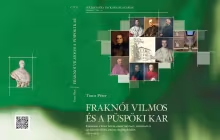
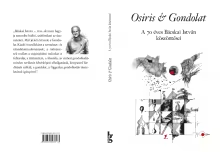
    The Dioceses and Bishops of Hungary (1804–1918). Institutional and Biographical Encyclopaedia V, eds. Zsófia Szirtes–Péter Tusor–Tamás Véghseő–Rupert Klieber, collaborator: Olivér Kőhalmi, Budapest 2026 (221 pp. + [18] pp. annotated b/w plates + [1] p. map supplement).

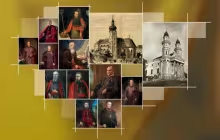
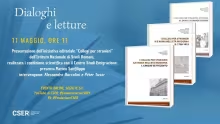
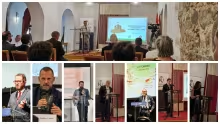
    The new year sees the continuation – once again, at Epiphany (cf. here) – of the Bishops’ Lexicon (I–IV, CST I/7), published in 2025 and devoted to nineteenth-century Latin-rite prelates, with a volume presenting the biographies of the bishops of the Greek Catholic dioceses of Hungary. Spanning 210 pages, the book introduces 31 hierarchs from seven dioceses: Mukachevo, Prešov, Hajdúdorog, (Alba Iulia–)Făgăraș, Oradea, Gherla and Lugoj. (The eighth Greek Catholic diocese of the Kingdom of Hungary, Križevci, falls – together with the Roman Catholic dioceses of Zagreb, Bosnia-Đakovo, and Senj-Modruš – within the remit of Croatian historiography as part of the Vienna-based project.)

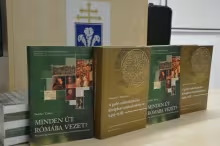
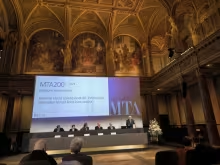
    As with Chapters I–IV – presented on 8 October 2025 in the ceremonial hall of the Central Seminary and structured by Latin-rite ecclesiastical provinces (with a separate chapter for the Territorial Abbey of Pannonhalma) – the introductory descriptions of the Greek Catholic dioceses and the bishops’ biographies in Chapter V follow a uniform structure and methodological approach. Unlike the first volume, however, the dioceses here are classified and arranged according to the Greek rite rather than by ecclesiastical provinces. Beyond the strictly ecclesiastical (Catholic) historical narrative, the biographical entries also incorporate perspectives from political, cultural, social, economic, and nationality history. The varied application of these approaches, together with the evaluation of episcopal careers, makes the lexicon suitable not only for scholarly use but also for a broader readership.

    The usability of the volume is enhanced by indexes of personal and place names. Several key figures and locations featured in Chapter V – constituting an independent volume of the Bishops’ Lexicon – are visually brought to life through a selection of archival photographs. The unified use of Chapters I–V of the two-volume lexicon (CST I/7 and I/9) and easier navigation are further facilitated by lists compiled according to three criteria: alphabetical order/page number, order of birth, and year of first appointment to office.

    The Greek Catholic Bishops’ Lexicon is the result of genuine teamwork, involving 16 authors and collaborators. The editors are Zsófia Szirtes and Péter Tusor on behalf of the Fraknói Research Group, Tamás Véghseő from the Greek Catholic Heritage Research Group, and Rupert Klieber of the University of Vienna. Olivér Kőhalmi served as collaborator; Márton Varsa as proofreader; and the indexes were prepared by György Sági, Csongor Cziráki, Attila Hőgye and Olivér Kőhalmi. Alongside the diocesan introductions and biographical entries authored or co-authored throughout by Tamás Véghseő, the volume also reflects the contributions of Margit Balogh (introductions), Jaroslav Coranic (Eperjes), Volodymyr Fenych and Viktor Kichera (Munkács), Blanka Gorun-Kovács (Gyulafehérvár-Fogaras, Szamosújvár), György Gorun-Kovács (Nagyvárad, Lugos) and György Janka (Hajdúdorog).

    The completion of the second volume of the Bishops’ Lexicon 1804–1918 also marks the beginning of a project spanning a millennium of history. Following the model of the German research project associated with Erwin Gatz, a biographical lexicon of Hungarian bishops from 1001 to 1993 will be produced. The planned volumes are: Bishops’ Lexicon 1918–1993; 1711–1804; 1605–1711; 1526–1605; 1458–1526; 1302–1458 and 1001–1302. In preparation for the Mohács anniversary year, the manuscript of the lexicon covering the Hunyadi–Jagiellonian period is already nearing completion (see the report by editor-in-chief Tamás Fedeles on this and on the project as a whole).

    The complete volume, published jointly by the Vilmos Fraknói Research Group, the Gyula Moravcsik Research Institute and the Collegium Professorum Hungarorum, and issued by Gondolat Publishing House, is available as a free downloadable e-book via the link provided here.

    4907
  • 2025. December 30.

    The primary profile of the Fraknói Research Group is the continuation of exploratory archival basic research, first and foremost in the Vatican collections, closely linked to the historical study of relations between Hungary and the Apostolic See, as well as to diocesan history. Its work is carried out in an institute-like framework within both the Hungarian university environment and an international Roman context.

    The main platforms for presenting its activities and publishing its results are its
    website: https://institutumfraknoi.hu/

    and its YouTube channel: https://www.youtube.com/channel/UCPscGUuIG1rnp13lnl_P3qg

    Dissemination is further supported through dedicated Facebook-, Instagram-, X- and Academia.edu pages.

    Below are comparative data on the 2025 audience figures of the website and the YouTube channel. Both platforms recorded more than 8,000 visits.


    Website

    In 2025, up to 29 January: over 8,000 active users (6,500 in 2024).

    Most visited pages in 2025:

    - 1. XI. Fraknói (Nyári) Akadémia 

    - 2. Kiadványok

    - 3. A Kutatócsoport nemzetközi konferenciája Rómában (INSR)


    Most popular books of the Research Group in 2025:

    1. Magyarország egyházmegyéi és püspökei (1804–1918)

    2. Fraknói Emlékkönyv

    3. A kalocsai érsekség évszázadai


    Most popular news items on the website in 2025:

    A Kutatócsoport nemzetközi konferenciája Rómában (INSR)

    PÜSPÖKLEXIKON 1804–1918 – Könyvbemutató a Központi Szemináriumban

    A Fraknói Kutatócsoport a székesfehérvári Mohács-konferencián


    Referral sources to the Research Group’s website:

    Google

    Facebook

    MTMT

    Gmail

    Magyar Kurír


    Countries of origin after Hungary:

    USA

    Romania

    Italy

    YouTube (255 subscribers, 283 videos)

    In 2025, 31 videos were uploaded, with a total of 8,287 views.

    The three most viewed recordings from the XI. Fraknói Akadémia, which placed Transylvanian diocesan history into a broader institutional-historical context:

    1. Bogdándi Zsolt: A narratio az erdélyi hiteleshelyek fejedelemségkori okleveleiben | XI. Fraknói Akadémia (1962 views)

    2. Szász Anikó: Mezővárosi írásbeliség és oklevél-kiállítás a hét erdélyi vármegyében (1540-1600) | XI. Fraknói Akadémia  (1199 views)

    3. Pakó László: Gyulafehérvár 17. századi jegyzőkönyve (1617-1643) | XI. Fraknói Akadémia  (624 views)


    In 2024, 28 new videos were published, with a total of 6,213 views.

    Most viewed videos in 2024:

    1. Kanász Viktor: Szász Móric 1552. évi magyarországi hadjárata | 9. Fraknói Műhelyelőadás (927 views)

    2. Életútinterjú Bergmann János nagypréposttal (897 views)

    3. Emlékülés Fraknói Vilmos halálának 100. évfordulóján | 2024. november 19. | Központi Szeminárium (541 views)


    Most popular uploads overall (since 2013):

    1.  Kerekasztal-beszélgetés a mohácsi csatáról | VI. Fraknói Nyári Akadémia (14 731 views)

    2. Tusor Péter: Az árpási oltárkép alternatív olvasata | 5. Fraknói Műhelyelőadás (4292 views)

    3.  Bogdándi Zsolt: A narratio az erdélyi hiteleshelyek fejedelemségkori okleveleiben | XI. Fraknói Akadémia (1962 views)


    4845
  • 2025. July 18.

    Between 17 and 19 July 2025, the academic conference entitled Central European History Convention was held at the University of Vienna. At the event, Viktor Kanász, research fellow of the Research Group, delivered a paper entitled “Relations between Rome and the Kingdom of Hungary in the Mid-16th Century, According to the Work of the Viennese Nuncios.” In his presentation, he outlined the narrowing of relations between the Holy See and Hungary in the decades following the Battle of Mohács, and highlighted the outstanding role and importance of the Viennese nunciature in Hungarian affairs. With regard to the sources, he emphasized that nuncial reports are of exceptional significance not only in ecclesiastical matters, but also from political and military perspectives.

    Program

    4846
  • 2025. June 23.

    Tamás Kruppa, Senior Research Fellow of the Research Group, gave a lecture in Monor on 22 June entitled The Bocskai Uprising and the Peace of Vienna. The event was organised by the Monorért Baráti Kör and the Monor–Nagytemplomi Reformed Parish. Following the lecture, participants laid wreaths at the memorial erected in commemoration of the Peace of Vienna concluded on 23 June 1606.

    4847
  • 2025. March 13.

    On 13 March 2025, at the Special College Conference of Pázmány Péter Catholic University (PPKE), Olivér Kőhalmi, a second-year history student at PPKE and a contracted collaborator of the Fraknói Research Group, delivered a paper entitled “The Correspondence of the Literary Historian Ferenc Toldy and the Priest-Historian Vilmos Fraknói (1860–1874)”, thereby continuing the historiographical research initiated by the Fraknói Centenary.

    The lecture is also indirectly connected to the 200th anniversary of the Hungarian Academy of Sciences, as both Ferenc Toldy and Vilmos Fraknói were prominent and influential figures in the Academy’s nineteenth-century history.


    4848
  • 2024. November 14.

    On 28 October 2024, at the 11th Fraknói Workshop Lecture, I presented my latest research results under the title Fraknói, Haynald, Ipolyi and the Monumenta Vaticana Hungariae: Lessons of a Historiographical Discourse (2004–2024).

    The lecture reviewed my historiographical debate with Gábor Adriányi, who passed away in the summer of 2024, concerning the circumstances surrounding the establishment of the Monumenta Vaticana Hungariae. Drawing on newly identified sources, it was possible to clarify the history of what was arguably Fraknói Vilmos’s most important scholarly initiative and to resolve a question that had long remained open in historiography. The core of the problem lay in the tension between the predominantly secondary sources used by Adriányi and the primary documentation associated with Haynald and Fraknói, later incorporated into a historical narrative by Arnold Ipolyi.

    The ways in which this tension can be resolved, as well as the methodological approaches adopted in 1882 by leading figures of modern Hungarian historiography, are discussed in the recorded lecture and in its annotated written version (Collectanea Vaticana Hungariae, class III, fasc. 2), available for download here.

    The study is dedicated to the memory of Gábor Adriányi, who, even in the midst of a solution-oriented scholarly debate, consistently showed paternal goodwill toward the author and toward the Fraknói Research Group during the demanding work on the Bischofslexikon 1804–1918. As we were unable to attend his quietly announced funeral in Veszprém, this publication—together with the reproduction of his obiutary and a photograph taken at the University of Vienna on 18 September 2014—serves as a farewell in the centenary commemorative year of his great predecessor, Vilmos Fraknói.

    Péter Tusor

    Abbreviated version of the lecture and its ppt presentation (Hungarian Academy of Sciences, 28 November 2024).


    4864
  • 2024. December 6.

    On 4 December 2024, Péter Tusor gave an interview on the M1 television channel, prompted by the Vatican meeting held that day between Pope Francis and the Prime Minister of Hungary. As head of the Fraknói Research Group, he sought to raise his analysis above the level of day-to-day political discourse, which had characterised the conversations preceding the broadcast. In a similar situation, he would have articulated the same considerations with regard to any Hungarian prime minister, regardless of party affiliation or worldview.

    One day later, Viktor Kanász was interviewed on Kossuth Radio about the historical antecedents of the meeting and the distinctive features of diplomatic relations between Hungary and the Holy See. In this context, the Research Group’s senior research fellow referred to the symbolic significance of the Chain Bridge during the papal visit of 2023, as a link between East and West, and outlined the role and importance of the principal actors of papal diplomacy—legates and nuncios. He also emphasised that, during the struggles against the Ottoman Empire, Rome provided the Kingdom of Hungary with substantial diplomatic, financial, and military support.

    At the end of the year, Miklós Jávor, external research associate of the Group, presented on M1 a key stage on the path toward the canonisation of Áron Márton, focusing on the moment when Pope Francis declared the bishop Venerable.


    Péter Tusor's interview (18:20-tól)

    Miklós Jávor's interview

    4865
  • 2024. November 9.

    On 8 November 2024, the Military History Working Committee of the Pécs Regional Committee of the Hungarian Academy of Sciences (MTA PAB), in cooperation with the Paks Town Museum, organised the conference entitled Military History across the Ages. Recent Results of Military Historical Research in Southern Transdanubia II (Hadtörténet korszakokon át. Az újabb hadtörténeti kutatások eredményei a Dél-Dunántúlról II.) in Paks, where Viktor Kanász delivered a paper.

    In his presentation, Reports and Military Plans of the Vienna Nunciature Concerning the Blockade and Recapture of Kanizsa (1689–1690), Kanász analysed Holy See–related sources discovered during his research trips to the Vatican, shedding light on the blockade and recapture of Kanizsa. One of the most reliable indicators of the Holy See’s attention to military affairs can be observed in the activity of the papal nunciatures accredited to the Viennese court, above all in the content of their regular reports sent to the Eternal City. Accordingly, alongside outlining the framework of Holy See–Habsburg relations, the lecture examined the reports and military plans of the Vienna nunciature in order to assess how well informed Rome was about events during the pontificates of Popes Innocent XI and Alexander VIII, and how the nunciature itself sought to influence military developments.
    (The written version of the paper will be published in the 2024 volume of Zalai Múzeum.)

    In addition, on 5 November, at the Deák Ferenc County and City Library in Zalaegerszeg, Kanász spoke on the occasion of the presentation of the Historia Transdanubiana volume. His lecture addressed the relationship between József Mindszenty and the curacy of Eszteregnye, the 1936 jubilee of the Eszteregnye church, and the subsequent fate of its main altarpiece.


    4866
  • 2026. January 17.

    Between 16 and 18 January 2026, the Vestigia Research Group, in cooperation with the Institute of Historical Studies of Eszterházy Károly Catholic University (EKKE), organised a workshop in Eger, hosted in the university’s headquarter. Among the speakers were Viktor Kanász, Research Fellow of the Fraknói Research Group, and its demonstrator Olivér Kőhalmi.

    In his presentation, Viktor Kanász examined the little-known activities of papal troops in Hungary in 1542, drawing on previously unexplored sources from the Parma State Archives. Of particular importance are the letters written from Komárom and Vienna by Giovanni Angelo de’ Medici, the future Pope Pius IV, which provide valuable insight into the movements, supply conditions, and reception of the papal forces, as well as into King Ferdinand I’s further plans concerning their deployment. In addition, the lecture incorporated other source groups, including letters sent to Rome from Ragusa, which illustrate the more distant reverberations of military events and shed light on the specific nature of information arriving from the Ottoman capital.

    Olivér Kőhalmi, together with Barnabás Guitman, Assistant Professor at the Institute of History of Pázmány Péter Catholic University (PPKE), delivered a joint paper entitled The Last Counsel of an Old Soldier. Their presentation analysed Giorgio Basta’s letter of 1606 addressed to Emperor Rudolf, in which the author argued against the Peace of Vienna, discussing its historical and political-theoretical line of reasoning. The speakers also identified the scribe responsible for drafting the letter and enriching it with historical and mythological exempla, as well as the works that served as its intellectual sources. A methodological peculiarity of the research lies in the fact that the Hungarian translation of the originally Italian text, as well as the resolution of the identity of a previously unidentified military officer, were achieved with the assistance of solution proposals generated by multiple artificial intelligence platforms.

    The three-day workshop provided an opportunity for fruitful scholarly exchange among the participants, while also offering insight into the Italian connections, history, book culture, and built heritage of the archiepiscopal city of Eger.

    4879
  • 2024. October 17.

    On 16–17 October 2024, the conference entitled Peaces and Treaties. Diplomatic History from Louis I to Francis II Rákóczi was held in Szeged, at the headquarters of the Szeged Academic Committee of the Hungarian Academy of Sciences (MTA SZAB) and at the premises of the Faculty of Humanities and Social Sciences of the University of Szeged (SZTE BTK).
    The Research Group was represented by Tamás Fedeles, who delivered a paper entitled Messer Giorgio – The Career of a Diplomat in the Age of King Matthias, and Tamás Kruppa, who presented The Background, Significance, and Aftermath of the Habsburg–Báthory Treaty of 1595.

    Program 1. 2.

    4869
  • 2024. May 25.

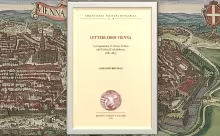
    On 23 May 2024, Volume XXI of the series Publikationen der ungarischen Geschichtsforschung in Wien (PUGW) was presented in Vienna. The monograph by István Fazekas, Die ungarische Hofkanzlei und ihre Beamten von 1527 bis 1690, was introduced by Thomas Winkelbauer. Thanks to the careful organisation of Iván Bertényi Jr., the event—marked by lively interest—was hosted at the Vienna seat of the Hungarian Embassy, located in the former palace of the Hungarian Court Chancellery.
    This early modern institutional history, based on a prosopographical methodology, represents a work of fundamental importance for both Hungarian and Austrian scholarship and constitutes one of the most valuable and enduring contributions to the Viennese Hungarian historical series. Numerous well-known figures from Austrian archival and academic circles were present at the event.

    By contrast, 21st-century Hungarian diplomacy has, as a rule, shown little understanding of scholarship and its modes of operation. It frequently relies on ad hoc, purely representational events—such as the one organised in October 2022 at the Palazzo della Cancelleria in Rome—which conspicuously lack any solid scholarly foundation. One may, of course, send people abroad and repeatedly spend Hungarian taxpayers’ money on visual design in the service of individual career ambitions, but such efforts are, in essence, devoid of real meaning. Science diplomacy without genuine scholarship is a contradictio in adiecto—a wooden iron. I write this on the basis of nearly three decades of experience in Rome.

    In Vienna, by contrast, scholarship and diplomacy consistently go hand in hand. Indeed, the Hungarian Embassy in Vienna regularly facilitates the reception of major historical research projects by making the splendid ceremonial hall of its palace in Bankgasse available for the presentation of important scholarly works. This was the case, for example, with the Bischofslexikon (see here). All this takes place without any direct or indirect party-political overtones, a fact that deserves particular emphasis.

    Behind this stands the cooperation between the Collegium Hungaricum in Vienna, the historical institute operating within its framework, and the Viennese archival delegation—and, personally, the work of István Fazekas, Gábor Ujváry, András Oross, Krisztina Arany, Iván Bertényi Jr., and others. This cooperation finds its most tangible expression in the jointly edited scholarly series produced by these three institutions. Through this series, the Fraknói Research Group is also connected to Hungarian historical research in Vienna, since the PUGW is the twin series of the Collectanea Vaticana Hungariae (CVH), as I have previously explained (see here). It is no secret that this twin-series concept follows a Vatican archival model, which has met with approval both in Rome and in Vienna.

    To what I already outlined in 2018, it is worth adding that both the conceptual and practical idea for the PUGW originated directly from the CVH. The guiding question was simple: if Vatican-based research already has a well-conceived and practical scholarly series, why should Hungarian historical research in Vienna not have—mutatis mutandis—a similar one, drawing on the same know-how and typographical infrastructure? My only hesitation concerned the fact that the additional workload would delay the CVH by three to four volumes. In the end, I concluded that, if successful, a new Viennese series would justify this sacrifice.

    In 2008, during one of my last extended research stays in Vienna, I began to discuss these ideas more intensively with my mentor and friend István Fazekas, considering the realistic possibilities of implementation. The PUGW was the result of this shared reflection. Its rapid launch was urgently needed, not least in order to publish conference proceedings from earlier years of the Collegium Hungaricum. A decisive step in the founding process was István Fazekas’s success—assisted decisively by Anna Fundarek—in convincing József Kelenik, then director of the BMTI, of the importance, usefulness, and feasibility of the project.

    I record all this primarily for the future rather than the present, since the PUGW is now regularly referred to—both retrospectively and today—as an initiative originating from the Viennese Hungarian institutions themselves, indeed as one of their official undertakings. This shift in perception is, of course, a welcome development and a clear, visible sign of the series’ viability, consolidation, and success.

    Not only is the overall design of the PUGW (cf. here) identical to that of the CVH—apart from the fact that the involvement of Gondolat Publishers was no longer necessary—but, in agreement with István Fazekas, I also modelled the copyright pages of the first volumes on the CVH. Although this was not legally required even at the time, I included, for example, a responsible publisher, thereby enhancing the prestige of the new series.

    Considerable thought was devoted in 2009 to the name of the series. The stylistic model was the Austrian Publikationen des ehemaligen österreichischen Historischen Instituts in Rom. Since three institutions stand behind the PUGW, a collective designation was required. Among several possibilities, I opted for Ungarische Geschichtsforschung in Wien, a choice that also met with the approval of my co-founder, István Fazekas. Under this title, the series is suitable not only for publishing archival research conducted in Vienna and Austria, but also for presenting any result of Hungarian historical scholarship worthy of publication in Vienna and, by extension, before the entire German-speaking scholarly world.

    A particular distinction of the PUGW is that it obtained an international ISSN number (2073-3054) from a French issuing centre. As a consequence, Hungarian historical research has, for fifteen years now, possessed a foreign-published, internationally registered series (recognised as such in the MTMT) in which Hungarian historians can publish at high quality, quickly, simply, and—above all—at very low cost. In other words, there is no need to enrich the profits of international publishers with millions from Hungarian institutional or grant budgets in order to achieve internationally visible publications. Thanks to the distribution system reorganised by András Oross, the PUGW is now present in major European and non-European public libraries.

    This represents a unique opportunity, the full exploitation of which has only just begun. As a curiosity—and ultimately for the record—it may be noted that the Roman numeral numbering of the PUGW was essentially accidental. I myself typeset Volumes I, III, and IV; Volume II was produced in Pécs under my supervision. Because the digit “1” of the digitally cut Tótfalusi Antiqua used for the CVH closely resembles a capital “I”, the Pécs typesetter interpreted it as a Roman numeral and numbered the second volume accordingly. I ultimately did not correct this—although placing, for example, a Roman numeral XXXVIII on the spine of a thinner volume may one day pose a challenge. The temptation of the hidden game, whereby the Roman numeral alludes to the Vatican connection of the PUGW, proved stronger. Although the annotation system underwent some changes from Volume V onwards, the bibliographical typology of the PUGW and CVH remains essentially identical.

    After minor and major fluctuations, the PUGW now appears to have stabilised. A clear sign of this is that, alongside the editorial board, András Oross has assumed responsibility as managing series editor, while—thanks to Krisztina Arany—the Viennese archival delegation has taken on an increasingly substantial role alongside the historical institute. The implementation of the pugw.at series website, proposed by me in a conversation with András Oross in Vienna in early December 2023, will open a new chapter in the history of the PUGW and, with it, of Hungarian historical research in Vienna. In the future, digital versions of PUGW volumes will become available online in a more visible, more uniform, and above all faster manner. Since the series’ own website is expected to be completed only by spring 2025, the newly prepared e-book version of Volume XXI, presented recently in Vienna, is currently accessible and downloadable via institutumfraknoi.hu (here).

    The key to further development lies in the consolidation of financial foundations, with state and academic backing. The Viennese legacy of Árpád Károlyi and Kuno Klebelsberg unquestionably deserves this.
     

    Péter Tusor

    INVITATION

    PROGRAM

    4870
  • 2024. April 11.

    On 6 April, Gábor Nemes, Senior Research Fellow of the Fraknói Research Group, appeared on the Hungarian television channel M5 in the history magazine programme História, which focused on Cardinal Tamás Bakócz, Archbishop of Esztergom. Drawing also on the results of his research in the Vatican Archives, Nemes discussed the cardinal’s stay in Rome, his chances in the papal election, and the conclave that ultimately resulted in the election of Pope Leo X. He also addressed the possible intentions behind Pope Leo X’s decision to appoint Bakócz as papal legate.

    On the same day, Viktor Kanász, Research Fellow of the Group, gave an interview in Nagykanizsa for Országjáró, a programme broadcast by Kossuth Radio. Based on his research in ecclesiastical and military history, he presented the life of György Thury, captain-general of Kanizsa, the circumstances of his death, and the presumed location of his burial. 


    4871
  • 2024. April 4.

    On 3 April 2024, Tamás Fedeles, co-head of the Fraknói Research Group and Head of Department Professor at the Faculty of Humanities and Social Sciences of the University of Pécs, delivered a lecture entitled “The Last Medieval Hungarian Duke: Lawrence of Ilok (1459/60–1524)” as part of the Medieval Evenings lecture series at the Faculty of Humanities and Social Sciences of Pázmány Péter Catholic University.

    The occasion for the lecture was provided, on the one hand, by the approaching 500th anniversary of Lőrinc Újlaki’s death, and on the other by the advanced stage of Professor Fedeles’s forthcoming monograph devoted to the duke’s life and career.


    4883
  • 2024. February 29.

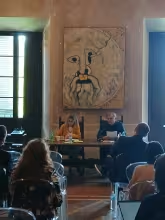
    On 29 February 2024, beginning at 5:30 p.m., the book launch of Secretum, Papi, guerre, spie: misteri dell’Archivio Vaticano svelati dal Prefetto che lo guida da un quarto di secolo, Intervista con Mons. Sergio Pagano (Popes, Wars, Spies: Mysteries of the Vatican Archive Revealed by the Prefect Who Has Led It for a Quarter of a Century. An Interview with Monsignor Sergio Pagano) took place in Rome. The distinguished event was hosted in the ceremonial hall of the Fondazione Marco Besso, located in the heart of the Eternal City at Largo di Torre Argentina. Alongside the author, Monsignor Sergio Pagano, Bishop-Prefect of the Vatican Apostolic Archive, numerous journalists and a large audience of interested guests were in attendance. Representing the Vilmos Fraknói Vatican Historical Research Group (PPKE–PTE HUN-REN), Katalin Nagy—Vatican archival research resident of the Research Group and research fellow of the Gyula Moravcsik Institute—was present. What follows is her brief report on the event.

    The book presentation was opened by Paolo Pagliaro, Editor-in-Chief of La Repubblica and himself the author of several books. He drew particular attention to the title Secretum, which deliberately evokes the former name of the “Vatican Secret Archive.” He emphasised that many of the documents preserved in the Archive still await thorough scholarly investigation in order to be properly interpreted. Numerous questions remain unanswered to this day, notably concerning the pontificate of Pope Pius XII and figures such as Galileo Galilei.

    The second speaker was Paolo Mieli, former Editor-in-Chief of Corriere della Sera. In his remarks, he highlighted that Monsignor Pagano’s book offers a balanced and well-founded portrayal of Pope Pius XII in relation to the events of the Holocaust. The same methodological sobriety, he noted, characterises the treatment of topics such as King Henry VIII of England and the discovery of America. Lucio Caracciolo, Editor-in-Chief of the Italian Geopolitical Review, focused on the meaning of Pope Pius XII’s silence, even in light of the well-documented fact that the Church provided extensive assistance to Jews subjected to persecution.

    Finally, Massimo Franco, also a member of the editorial board of Corriere della Sera, observed that Monsignor Pagano—having worked as an archivist for forty-five years and as Prefect for twenty-seven—possesses an unparalleled knowledge of the Vatican archival fonds and their secrets. He noted that in a secluded part of the Archive, documents had been discovered indicating that Pope Pius XII maintained a well-organised political intelligence network, bordering on a “spy system.” At the same time, some of these documents suggest that materials deemed sensitive for the Church may have been destroyed. In this regard, Franco stressed that historical facts must not be concealed.

    Towards the conclusion of the event, Monsignor Pagano himself addressed the audience, adding that archival documents attest that Pope Pius XII held several bank accounts with different financial institutions, one of which was used specifically to provide material assistance to Jews. He further noted that the Pope’s silence regarding the situation of the Jews can be interpreted in various ways, including the possibility that he sought to avoid worsening their already precarious circumstances and thus felt compelled to remain silent, despite his genuine concern for their plight.

    The event was followed with great interest by numerous university lecturers, Italian and international researchers, journalists, and members of staff of the Vatican Apostolic Archive.
     

    4884
  • 2024. February 27.

    The Fraknói Research Group attaches particular importance to the dissemination of the results of its fundamental scholarly research. In this spirit, during 2023, and on the basis of an agreement concluded with the historical magazine Múlt-kor, members of the Fraknói Research Group published two articles (see here and here).

    Owing to the strong interest these publications generated, this initiative subsequently developed into the central thematic focus of the magazine’s spring issue this year. Edited jointly by Péter Tusor and Viktor Kanász, the thematic section features contributions by Péter Tusor, Tamás Fedeles, Gábor Nemes, Tamás Kruppa, Viktor Kanász, György Sági, and Róbert Oláh P. on behalf of the Research Group, exploring the thousand-year history of relations between Hungary and the Holy See.


    4885
  • 2024. November 7.

    Between 7 and 9 November 2024, the Conference of Young Scholars (FIKON), entitled Temporality and Memory: Past and Future in Antiquity, was held at the University of Szeged. The conference venues were the Rector’s Building of the University of Szeged and, on the final day (Saturday), the Móra Ferenc College for Advanced Studies of the University.

    The papers were delivered in eight thematic sections. The speakers were students and doctoral candidates from Babeș–Bolyai University (Kolozsvár/Cluj-Napoca), the Universities of Debrecen, Pécs, Óbuda, and Szeged, as well as Eötvös Loránd University (ELTE).

    Representing the Fraknói Research Group, Tamás Kruppa participated in the conference as chair of the section Dynastic Memory and Individual Career Paths.


    4886
  • 2024. December 6.

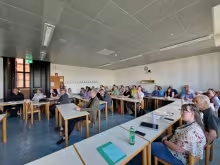
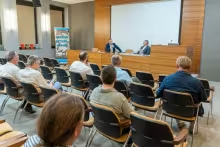
    On 8–9 December 2024, the international conference ANTEMURALE CHRISTIANITATIS. Central Europe and the Western Balkans as the Bulwarks of Christianity was held at the Várkert Bazár in Budapest, with the collaboration of the Fraknói Research Group. Three members of the Research Group delivered papers at the conference.
    Gábor Nemes delivered a paper entitled “The ‘Ottoman Policy’ of the Apostolic See.” In his presentation, he examined the evolution of papal diplomacy towards the Ottoman Empire from the 1440s onward, with particular emphasis on the period following the fall of Constantinople in 1453. He demonstrated that resistance to Ottoman expansion became one of the central objectives of papal foreign policy, and that papal legates sent to the Kingdom of Hungary played a decisive role in organising and sustaining anti-Ottoman efforts. Drawing on several historical examples—from Cardinal Giuliano Cesarini’s pivotal involvement in the 1444 campaign to Juan de Carvajal’s contribution to the victory at Belgrade in 1456—he highlighted the legates’ political, military, and financial responsibilities. The lecture also addressed the activities of papal legates during the Jagiellonian period, focusing on their diplomatic missions, the management of papal subsidies, and their attempts to strengthen Hungary’s internal and external position in the face of an imminent Ottoman threat.

    Tamás Kruppa presented his lecture “Diplomatic Relations between the Republic of Venice and the Ottoman Empire (1499–1540).” Framing his analysis between two Venetian–Ottoman wars, he explored the complex and multifaceted relationship between the two powers. He emphasised that Venice’s prosperity depended heavily on Levantine trade, which encouraged the Republic to pursue a policy of maintaining the status quo vis-à-vis the rising Ottoman Empire. At the same time, Venice’s mainland possessions drew it into the prolonged Italian Wars from 1494 onward, increasing its vulnerability to pressure from Istanbul. In contrast, Ottoman strategic objectives were clear: to limit Venetian influence in the eastern Mediterranean, particularly in the Balkans and Dalmatia, and to expand territorially by securing key islands in the Aegean–Adriatic region. Kruppa demonstrated how Venetian diplomacy oscillated between cooperation and confrontation, while Ottoman diplomacy combined pragmatism with strategic foresight, seeking simultaneously to avoid a two-front war and to prevent the formation of broader Christian–Muslim coalitions against the Empire.

    Tamás Fedeles introduced the ongoing Bishops’ Lexicon (1458–1526) project in his lecture entitled “The Hungarian Ecclesiastical Elite at the Boundary between the Middle Ages and the Early Modern Period.” Beginning with the observation that two archbishops and five bishops perished on the battlefield of Mohács in 1526—representing nearly half of the Hungarian episcopate—he underscored the loyalty and sacrificial commitment of the ecclesiastical elite to the defence of the realm. His presentation outlined the aims and preliminary results of a long-term research programme that seeks to produce modern scholarly biographies of the seventy-five prelates who headed Hungary’s fourteen dioceses between 1458 and 1526, in preparation for the battle’s 500th anniversary. Beyond biographical reconstruction, the project also examines the contemporary condition of the dioceses themselves, supported by cartographic visualisation, and offers a prosopographical analysis of the late medieval Hungarian episcopate, addressing questions of origin, education, careers, patronage networks, and royal appointment policies.
     

    (Pictures: Kálmán Tábori and Viktor Kanász)

    4887
  • 2023. March 10.

    On 10 March 2023 at 5:00 p.m., the second session of the Seminario permanente di Storia del Papato (Permanent Seminar on the History of the Papacy) was held, a new initiative jointly launched by the Pontifical Gregorian University and the Archivum Historiae Pontificiae. On this occasion, Caterina Capuccio, a medieval historian affiliated with the University of Wuppertal, delivered a lecture entitled La Cappella papale: origine e sviluppo di un’istituzione della Curia romana (12th–13th centuries). The Fraknói Research Group was represented at the event by its Vatican archival research resident, Katalin Nagy.

    The seminar was opened by Andrea Verardi, Associate Professor at the Pontifical Gregorian University, who briefly introduced Caterina Capuccio’s academic background and the subject of her research, noting that the results of the dissertation presented would be published in monograph form in the near future.

    In her lecture, Caterina Capuccio first outlined the papal chaplaincy as an institution in general terms. Papal chaplains (or subdeacons) were clerics closely attached to the person of the pope: they were ordained by him and could receive higher orders only with his explicit permission. Capuccio then presented the methodological framework of her research, emphasizing that many papal chaplains exercised their activities not only in Rome but also within other dioceses. In this sense, they constituted a kind of functional elite of the papacy. A significant number of them were later consecrated as bishops, created cardinals, or—most notably in the case of Pope Innocent III—even elected pope.

    Capuccio stressed that her dissertation focuses on the formative phase of the papal chaplaincy, from its initial emergence in 1046 up to the end of Innocent III’s pontificate (1198–1216). The project concentrates primarily on the ecclesiastical provinces of Milan and Salzburg, and its core consists of a prosopographical analysis of the members of the papal chapel.

    4888
  • 2023. March 27.

    On 25 March 2023, an interview with Tamás Kruppa, Senior Research Fellow of the Fraknói Research Group, was broadcast on Vatican Radio. The conversation focused on his volume Papal Troops in Hungary (1595–1597, 1601), published as CVH I/17, which is available for download here.

    The interview can be listened to from 8:40 at the following link.


    4889
  • 2023. April 26.

    On the occasion of Pope Francis’s visit to Hungary, the Faculty of Humanities and Social Sciences of Pázmány Péter Catholic University featured interviews with two members of the Fraknói Research Group, Gábor Nemes and Viktor Kanász, in the latest episode of Hic et Nunc Aktuál.

    In the discussion moderated by Kristóf Dallman, a number of particularly intriguing and significant aspects of the historical relationship between the papacy and Hungary were addressed. The conversation touched upon King Saint Stephen and the sending of the crown, the Investiture Controversy, Sigismund of Luxembourg and the Council of Constance, Tamás Bakócz’s stay in Rome, the assassination of Cardinal György Martinuzzi, the Hungarian-related reports of sixteenth-century papal nuncios, as well as Péter Pázmány’s Roman connections and contemporary perception.

    The episode is available to listen to here.

    4890
  • 2023. April 27.

    In connection with the papal visit, the Fraknói Research Group has been actively involved in the organisation of several events in recent weeks. On 11 April, at the invitation of Pázmány Péter Catholic University, the Research Group participated in the preparation and moderation of a roundtable discussion. It also contributed to the editing of a special, papacy-themed issue of Rubicon, initiated by the Group, and members of the Research Group gave interviews for the podcast series of the Faculty of Humanities and Social Sciences of PPKE.

    Within the framework of the Latinitas Hungarica lecture series, jointly organised by the Department of Classical Philology of PPKE and the Moravcsik Gyula Institute of the Faculty of Humanities, lectures were delivered by Gábor Nemes and Péter Tusor. On 19 April, Gábor Nemes presented a lecture entitled Medieval Papal Charters in Hungary, while on 26 April Péter Tusor gave a lecture entitled The Hungarica of the Vatican Archives in the Early Modern Period.


    4891
  • 2023. August 13.

    On 12 August 2023, the consecration of the Church of the Assumption of the Blessed Virgin Mary in Eszteregnye took place. The liturgy was celebrated by Szabolcs Benedek Fekete, Auxiliary Bishop of Szombathely. In the afternoon, at the invitation of Fr Gottfried Heiter, Viktor Kanász, Research Fellow of the Fraknói Research Group, delivered a lecture on the church’s earlier consecration in 1936.

    In his presentation, Kanász reconstructed the events on the basis of a previously unknown body of documents that had remained in private ownership and was entirely unknown to scholarship until now. He discussed the role of József Pehm (later Cardinal Mindszenty), then provost-parish priest of Zalaegerszeg, who performed the consecration on 15 August 1936, and presented several hitherto unpublished letters by Mindszenty preserved in the archival material. Special attention was given to the process of the church’s renovation and to the circumstances surrounding the creation of the new altarpiece painted by Géza Szánthó.

    The written version of the lecture will be published next year in the form of a scholarly article.

    4892
  • 2023. September 2.

    Tamás Kruppa gave an interview to Vatican Radio about the documentary edition of Ferenc Forgách edited by him (Documenta of Ferenc Forgách, CVH II/9). In the course of the interview, he spoke with Fr László Vértesaljai about the former Archbishop of Esztergom, discussing his personality, historical significance, and his role in the history of Hungarian Catholicism, with particular reference to the published source material.

    4893
  • 2026. January 27.

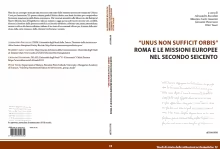
    In 2025, the volume Protagonisti e Collaboratori – Studiosi provenienti dall’Europa centro-orientale presso gli archivi della Santa Sede tra il 1881 e il 1918 (“Protagonists and Collaborators: Scholars from Central and Eastern Europe in the Archives of the Holy See between 1881 and 1918”) was published. The book contains the proceedings of the international conference held on 6 June 2024 at the Aventine headquarters of the Istituto Nazionale di Studi Romani, in the immediate vicinity of the headquarters of the Sovereign Military Order of Malta.

    One of the editors of the volume, Katalin Nagy, who also serves as the Vatican archival research resident of the Fraknói Research Group, briefly presented the book on Vatican Radio in a conversation with Fr. László Vértesaljai. Vatican Radio has long served as an important forum for the Research Group to present its current scholarly results and to introduce Urbi et Orbi the latest volumes of the Hungarian Vatican historical series. (Recent appearances include broadcasts in 2025, 2024—see here, here, and here—and in 2023—see there, here, here, and here, among others.)

    The radio interview can be listened to below.

    The volume is available for free download here.

    4906