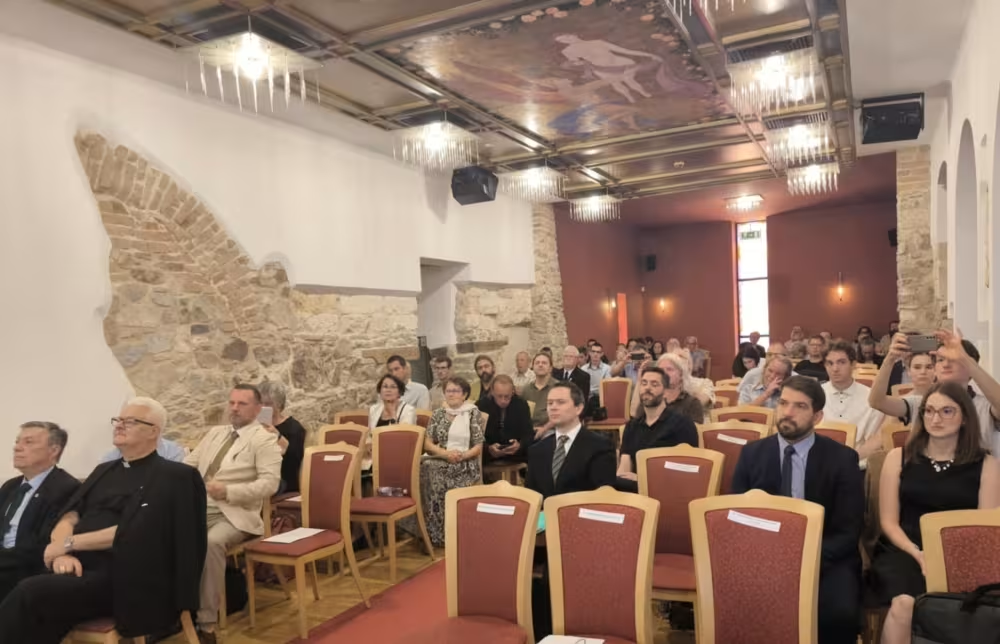
Under the title “We have not come to celebrate, but to pay the tribute of reverence …”, an academic conference on the Battle of Mohács and its age was convened by the Municipality of Székesfehérvár, the Institute and Museum of Military History, and János Kodolányi University within the framework of the Royal Days of Székesfehérvár, held on 18–19 August 2025. Bringing together many of the foremost figures in Mohács scholarship, the conference represented a landmark contribution to ongoing research into one of the pivotal moments of Central European history. The Fraknói Research Group also participated, presenting under the chairmanship of Péter Tusor a dedicated panel on the ecclesiastical dimensions of Mohács on the morning of the second day. (The full programme of the conference is available here.)
The first paper of the session was delivered by Tamás Kruppa, Hungarian–Ottoman Peace Negotiations and Peace Initiatives before Mohács (presentation available here). Making use of both well-known and previously overlooked Venetian diplomatic reports, he provided a nuanced survey of the diplomatic interactions between the court of Buda and Istanbul from 1500 to 1526—offering fresh perspectives on late medieval diplomacy at the intersection of East and West.
In his lecture, Tamás Fedeles examined The Role of Ecclesiastical Army in the Hungarian–Ottoman Wars of the 1520s (see presentation here). He demonstrated how, in the Jagiellonian era, the ever-growing Ottoman menace along the southern frontier prompted substantial innovations in the organisation of national defence, inevitably shaping the involvement of the clergy. The decisive turning point, however, came with the decree of King Wladislas II in 1498, whose 20th article required ecclesiastical prelates and institutions to provide a total of 6,900 armed men. Fedeles illustrated through numerous case studies how ecclesiastical contingents participated in the campaign for the recapture of Belgrade (1521), in smaller Hungarian victories in Syrmia (1523), and, most fatefully, in the Battle of Mohács (1526). At Mohács, roughly 20% of the entire Hungarian army consisted of ecclesiastical troops—an impressive proportion underscored by the fact that half of Hungary’s high clergy perished in the encounter, including two archbishops and five bishops. These findings reinforce the conclusion that ecclesiastical military forces were integral to the anti-Ottoman struggles of the Jagiellonian period, not merely marginal auxiliaries.
Gábor Nemes, in his paper The Papacy’s Struggles against the Ottomans before 1526, provided a broader transnational perspective, situating Mohács within the evolving history of papal diplomacy and crusading ideology. He analysed the papacy’s seminal role in the emergence of the crusading ideal and the transformations it underwent in the Renaissance era, particularly under the impact of humanism. From the 1440s onwards, and especially after the fall of Constantinople in 1453, the struggle against the Ottomans became a primary objective of papal diplomacy. Nemes highlighted the crucial roles played in Hungary by cardinal legates such as Giuliano Cesarini, Juan de Carvajal, Pietro Isvalies (1500–1503), Tommaso de Vio (1523–1524), and Lorenzo Campeggi (1524–1525), whose interventions reveal the international embeddedness of Hungary’s anti-Ottoman wars.
Advancing chronologically, Viktor Kanász presented Money, Horses, Arms. Papal Assistance in the Anti-Ottoman Struggles in the Decades after Mohács (presentation downloadable here). His paper examined the multifaceted forms of papal assistance—diplomatic, financial, and military—in the aftermath of Mohács. He stressed that such efforts should be seen as a natural continuation of medieval precedents, even though papal objectives ultimately went unfulfilled, due largely to the altered geopolitical realities of both Europe and the papacy. Yet these endeavours paved the way for later developments: half a century later in Gianfrancesco Aldobrandini’s campaigns, and ultimately, in the late seventeenth century, in the decisive achievements of the Holy League under Pope Innocent XI, which culminated in the liberation of the Kingdom of Hungary.
In his lecture The Memory of Archbishop Pál Tomori in the Archdiocese of Kalocsa (from the Early Twentieth Century to the Present), György Sági offered a case study in ecclesiastical memory politics. He traced how Tomori, who had fallen heroically at Mohács, was remembered by his successors over the course of more than a century, often held up as a model of steadfastness. From church commemorations to secular memorial initiatives, Sági demonstrated how the figure of Tomori remained a reference point for local identity and collective remembrance. (presentation available here)
The concluding session, presented by Viktor Kanász and Katalin Nagy, addressed In the Shadow of Burgio. The Papal Nuncios in Budapest and the Memory of Mohács (presentation available here). Their study analysed the role of papal nuncios in the commemorations of the 1920s and 1930s, situating them within the wider field of transnational memory studies. At the centenary commemoration in 1926, Nuncio Cesare Orsenigo, acting as patron, received considerable public attention, yet deliberately distanced himself from the political dimension of the event. His successor, Angelo Rotta, likewise declined to participate in subsequent commemorations, citing other commitments. This deliberate reserve reflected the nuncios’ awareness that the commemorations were largely organised by political actors and offered little in the way of genuine diplomatic or pastoral opportunities. Their involvement thus remained passive, largely representative, and emblematic of the papacy’s cautious diplomacy in interwar Central Europe.
Beyond its presence at this conference, the Fraknói Research Group maintains multiple ties to Mohács-related scholarship. In September 2025, further results will be presented at a conference in Sárvár (see here), while under the leadership of Tamás Fedeles, the compilation of the Bishops’ Lexicon of the Jagiellonian Period continues (see here for earlier reports). Both initiatives testify to the Group’s role as a reference point in ecclesiastical historiography and as an active contributor to international scholarly exchange.
Full videos of the presentations are in preparation.
Downloads


