On June 12, 2025, the concluding symposium of the multi-year international project titled "Curia romana e nazioni europee" took place in the Eternal City, within the prestigious halls of the Istituto Nazionale di Studi Romani (the same venue where the Research Group had organized a conference last year in commemoration of the centenary of Vilmos Fraknói). Following the welcome address by Gaetano Platania, President of the INSR, renowned historians evaluated the results of the research carried out with the active involvement of the Research Group. Michaela Valenti (Sapienza), Massimo Giannini (University of Teramo), and Fr. Silvano Giordano, OCD (Gregorian University), under the chairmanship of Fr. Roberto Regoli (Gregorian University), assessed the significance of the research not only within the European context, but – through transatlantic relations – within universal historiography as well.
The project series began in 2018 with an international conference held at the headquarters of the Hungarian Academy of Sciences in Budapest. The structured findings of Italian, Spanish, French, German, Austrian, English, Portuguese, Canadian, Brazilian and Hungarian scholars have been published in volumes in English, Italian and French.
- 1. Gli agenti presso la Santa Sede delle comunità e degli Stati stranieri, I. Secoli XV-XVIII e II. Secoli XVIII-XX, a cura di Matteo Sanfilippo e Péter Tusor, Sette Città 2020 e 2021.
- 2. I Barberini e l’Europa, a cura di Péter Tusor e Alessandro Boccolini, Sette Città 2022
- 3. I collegi per stranieri a/e Roma nell’età moderna: I. Cinque-Settecento, a cura di Alessandro Boccolini, Matteo Sanfilippo e Péter Tusor, Sette Città 2023; II. 1750- 1915, a cura di Alessandro Boccolini, Philippe Roy-Lysencourt, Matteo Sanfilippo e Péter Tusor, Sette Città 2024; III. Dalla Grande Guerra a oggi, a cura di Alessandro Boccolini, Philippe Roy-Lysencourt, Matteo Sanfilippo e Péter Tusor, Sette Città 2025.
The evaluative analyses delivered on the Aventine Hill before a large audience can be listened to [here]. The volumes are available for download [here].
* * *
The symposium held at the INSR represented a particularly significant milestone in the overarching "master plan" of the Budapest-based Fraknói Research Group. According to this concept, the core archival research takes place in the Vatican, the extended process of scholarly analysis is conducted in Hungary, and the results are then presented once again in Rome – within a knowledgeable, prestigious international academic forum. Such was the case, for example, in 2018 at the Pontificia Università della Santa Croce and in 2022 at the German Historical Institute (DHI). Thanks to this method, the Fraknói Research Group has effectively been continuing Vilmos Fraknói’s scholarly work in Rome and representing his legacy for over two decades, since the launch of Collectanea Vaticana Hungariae in 2004. In doing so, it virtually fills the void left by the absence of a systematic, research-focused Hungarian Historical Institute in Rome that would investigate the Holy See’s collections in a scholarly capacity.
During the joint Roman research week of the Fraknói Research Group between June 8 and June 15, 2025, this „Historical Institute of Hungary in Rome” (RMTI) was effectively brought to life for the third consecutive time, following the similar programs of 2023 and 2024. The members, setting out each day from the Szent István House (Casa di Santo Stefano), engaged in primary research throughout the full opening hours of the Vatican Apostolic Archive, the Vatican Apostolic Library, the Archivio di Stato di Roma, the Archivio Storico Capitolino and the Historical Archives of the Secretariat of State. In their free time, they distributed copies of the Research Group’s latest publications – including the Fraknói Memorial Book and the Lexicon of Hungarian Bishops – to major Roman libraries, such as the Vatican Library, the Gregoriana, Santacroce, Corsini, and the German and Austrian Institutes. Meanwhile, they immersed themselves in the inexhaustible sights and artistic riches of the Eternal City, and in the evenings shared their scholarly and personal experiences over common dinners.
Due to the closure of the Vatican archives on June 9, 2025 – on account of the Vatican staff's Holy Year Jubilee – the Fraknói Research Group visited only Italian state archives in the morning. In the afternoon, they traveled to nearby Frascati, where they visited the famed Villa Aldobrandini, whose private archive holds the canonical investigation protocol of Cardinal Péter Pázmány. The planning meeting for the 2025/26 academic year also took place there.
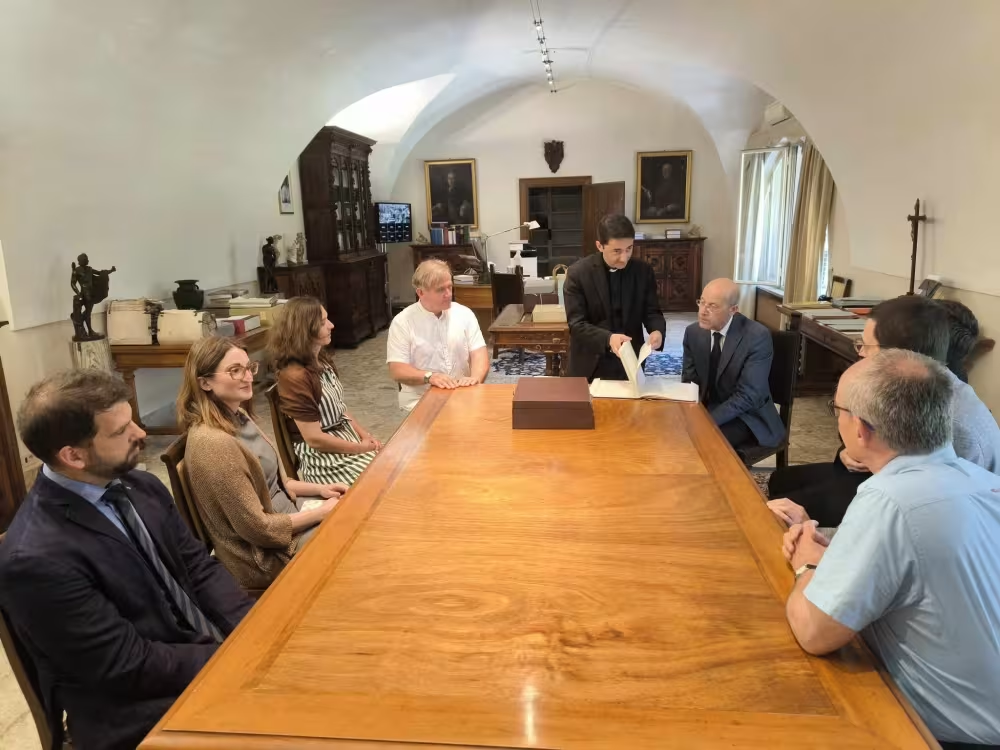
On the morning of Wednesday, June 12, 2025, the members of the Research Group, engaging in meaningful and authentic academic diplomacy, paid a courtesy visit to the new Prefect of the Vatican Apostolic Archive, Fr. Rocco Ronzani, O.S.A., to whom they presented several recent and reissued volumes of the Collectanea Vaticana Hungariae. (The speech by Research Group leader Péter Tusor can be read [here].)
The research activities and academic program were rounded out by excursions to historic sites around Rome – Genazzano, Fossanova, Terracina, and Ariccia – as well as a friendly football match against the Italian staff of the Szent István House, dubbed the “primo Fraknói-calcio”, appropriately held during the Jubilee Week for athletes.
Kornél Szovák, Director of the Moravcsik Institute and Secretary of the CVH Editorial Board established in 2002, as well as two former students of Pázmány Péter Catholic University, now historians, who were newly welcomed as honorary members were also participants of the Fraknói Research Group's 'RMTI Week'.
Downloads


