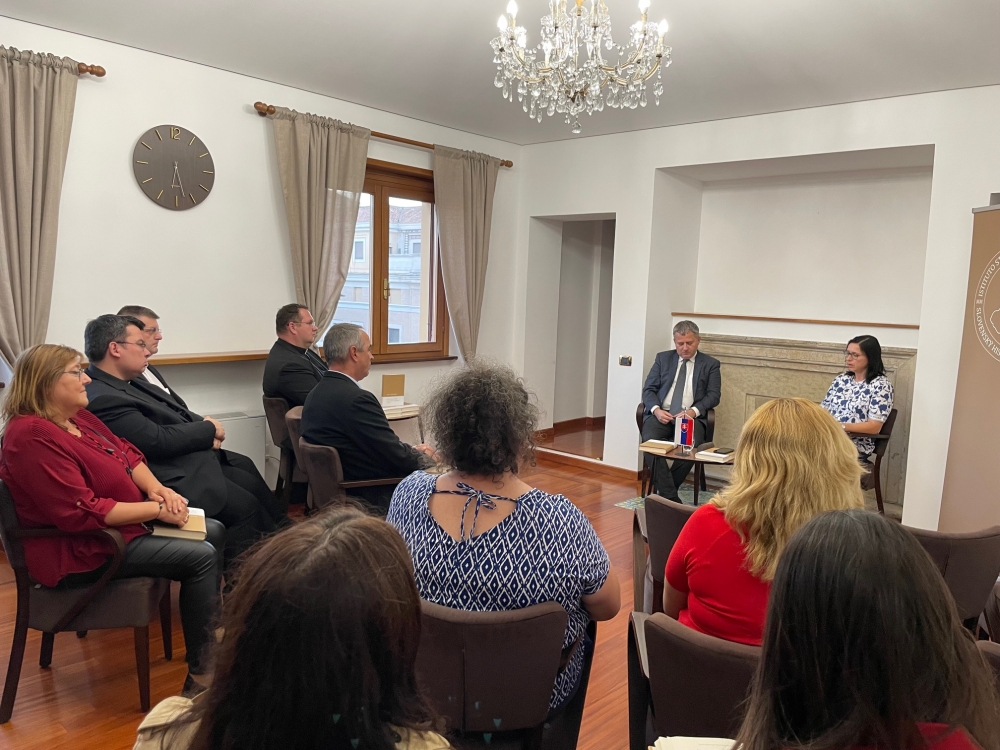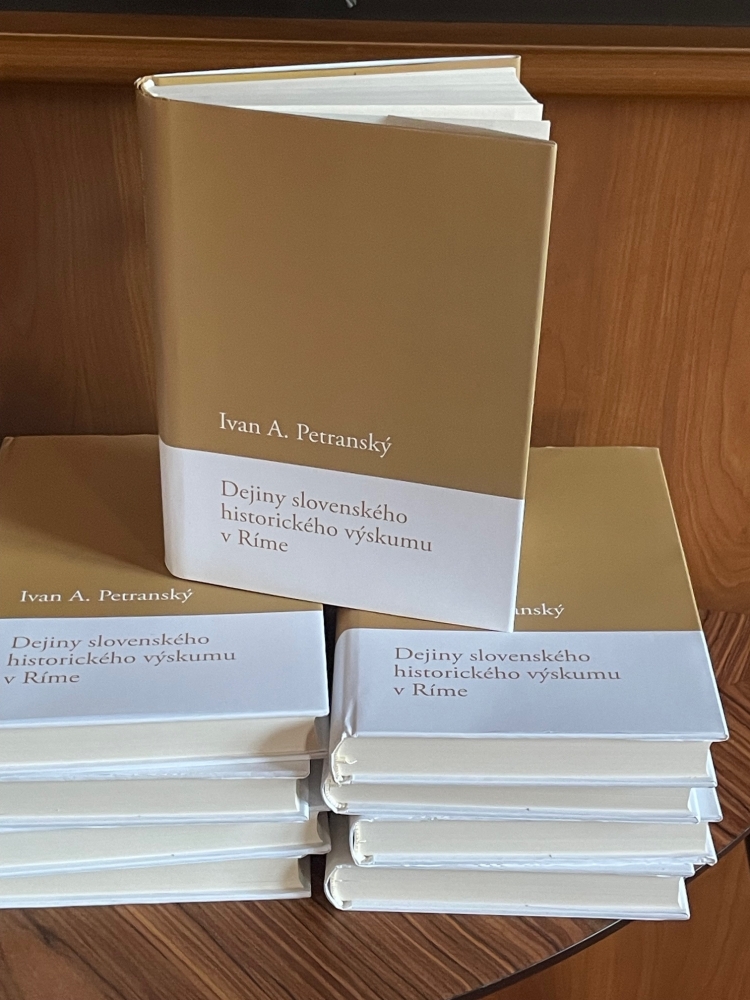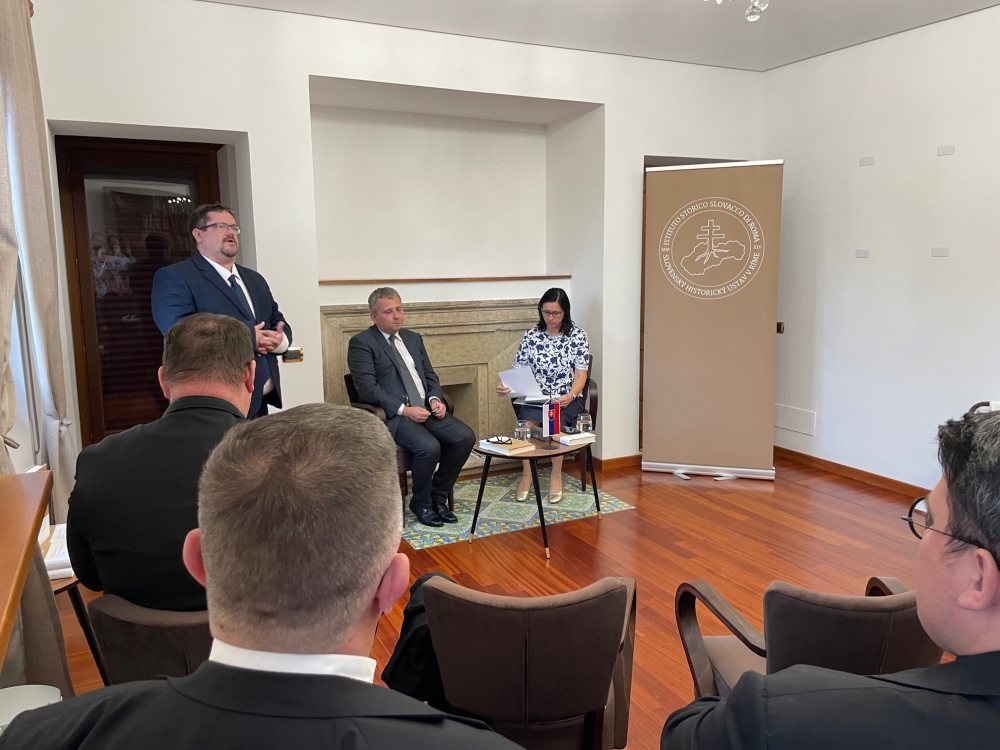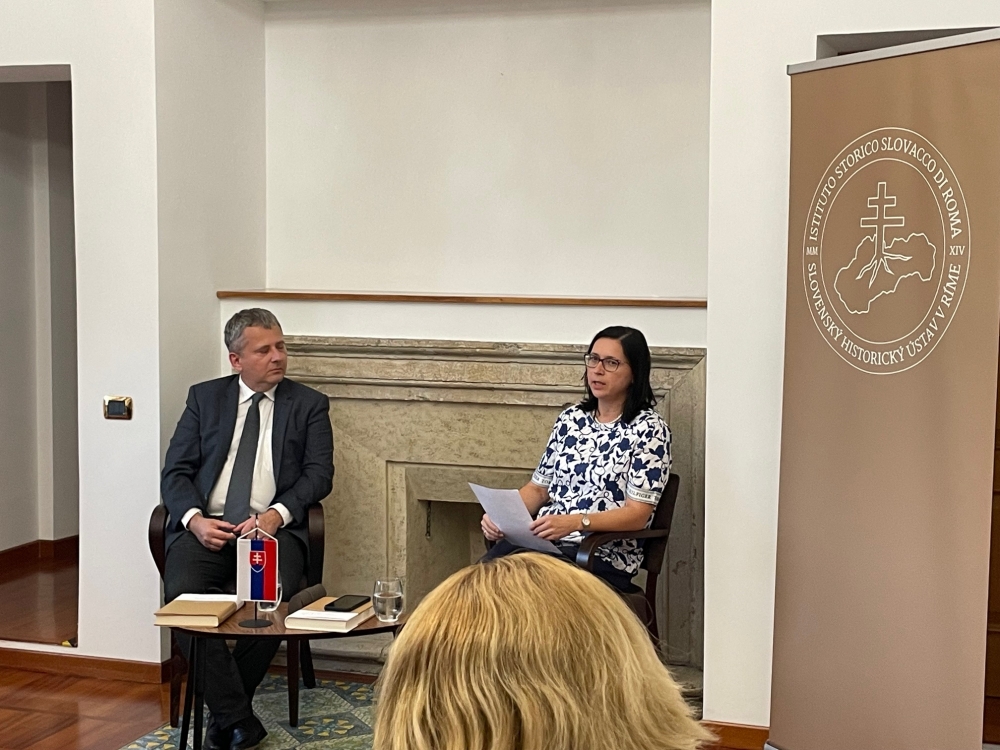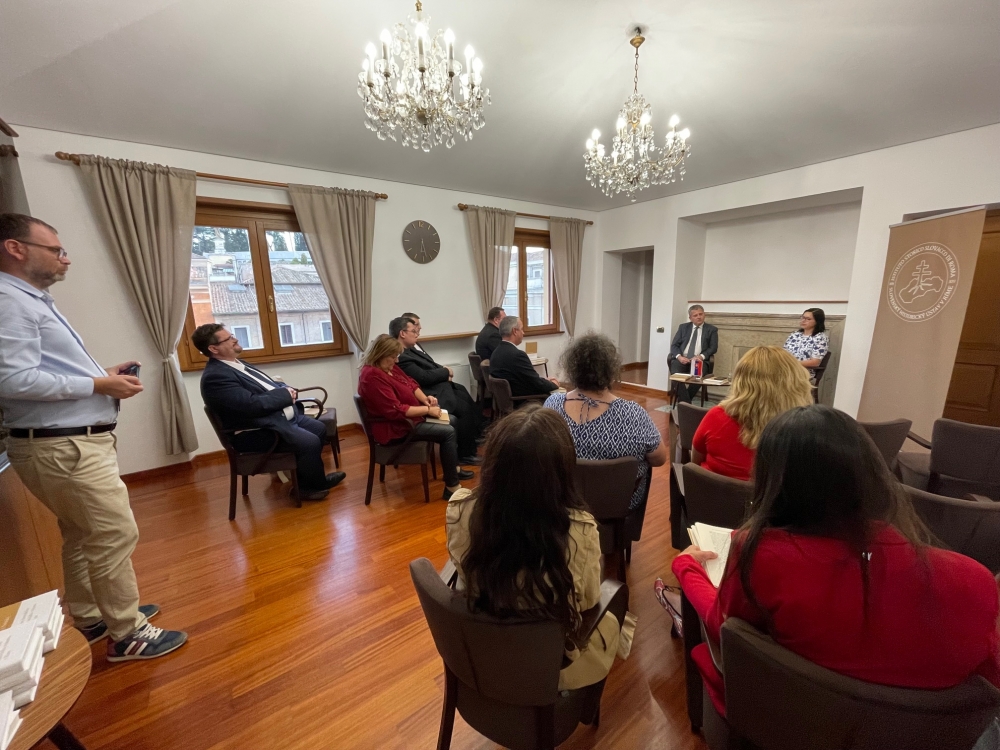
On Thursday, 9 October 2025, at 6:00 p.m., the Slovak Historical Institute hosted the book launch of Dejiny slovenského historického výskumu v Ríme [The History of Slovak Historical Research in Rome], authored by Ivana A. Petranský, a research fellow of the Institute. The event was moderated by the Slovak historian Beáta Katrebová Blehová. The Fraknói Research Group was represented on this occasion by Katalin Nagy, CPH fellow and resident researcher of the Group at the Vatican Archives.
The volume offers a comprehensive overview of the history and role of the Slovak Historical Institute in Rome from the post-1918 period to the present day. Since its foundation, the Institute has served as a key platform for Slovak historical scholarship to engage with the European academic community and to establish research relations in Italy – particularly through the systematic use of archival sources preserved in the Vatican.
The book provides a detailed account of how, from the very establishment of the Czechoslovak Republic, there was a strong ambition to represent the new state’s sovereignty also through the foundation of an institute in Rome. As a result of this initiative, the Czechoslovak Historical Institute was created between 1921 and 1923. This made it possible for Slovak historians, alongside their Czech colleagues, to conduct internationally relevant research both in the interwar period and thereafter, with special emphasis on the study of medieval sources.
After the Second World War, the Institute’s activity was repeatedly interrupted for political and financial reasons. During the Cold War, its intellectual tradition was sustained in Rome by Slovak émigré scholars and Catholic circles. From the 1960s onwards, new generations of researchers appeared who worked in Italian and Vatican archives; the book also presents in detail the scholarly achievements of several of these notable Slovak historians.
Following the political changes of 1989 and the attainment of Slovak statehood in 1993, new opportunities opened up for Slovak historians. The Slovak Historical Institute in Rome was established with joint state and ecclesiastical support. It received legal status in 2013 and has operated as an institutional body since 2014. Its academic background in Slovakia is provided by the University of Trnava [Nagyszombat]. Since then, the Institute has been continuously active in various academic and editorial fields: organizing source-based research in Vatican and Italian archives, hosting conferences and symposia, and publishing journals and scholarly volumes.
“The book places particular emphasis on the most recent research directions and projects, and on the ways in which the Institute contributes to the development of Slovak historical consciousness” – as stated in the main thesis of the presentation.
* * *
To this report, and especially to the closing sentence quoted above, it must immediately be added – from the standpoint of scholarship – that it is of paramount importance for Slovak historical research to ensure that its aspirations remain in full harmony with the authentic historical reality prior to 1918.
The successor institutions of the former Czechoslovak Historical Institute are, without doubt, functioning effectively in 21th-century Rome. Unfortunately, this cannot be said of the Roman Hungarian Historical Institute, which began its activity in 1924 in the Villa Fraknói, and whose work, already by the 1930s in the Palazzo Falconieri, had virtually ceased. Within the Hungarian Academy in Rome, the 'Istituto Storico Fraknói ' – which still nominally exists within the Collegium Hungaricum – engages in no visible or active scholarly activity whatsoever.
In contrast, Czech historical research has operated within a stable institutional structure since the 1990s. Within the Institute of History of the Czech Academy of Sciences, a commission composed of scholars with extensive research experience in Rome constitutes the Prague-based academic foundation of the Czech Historical Institute in Rome. The Institute itself shares premises in Rome with the Czech Ecclesiastical Institute. It publishes its own periodical (Bollettino dell’Istituto Storico Ceco di Roma) and maintains several newly established as well as long-standing series of scholarly publications (for all this, see the Institute’s official website). To our knowledge, the Czechs do not maintain a so-called “cultural institute” in Rome.
The Slovak Historical Institute, by contrast, began its operation in 2014 within the building of the Slovak Institute in Rome – an institution comparable to the Hungarian Academy in Rome, directed by diplomats and serving primarily as a cultural center. In 2023, it relocated to the Via della Conciliazione, in the immediate vicinity of the Vatican. The new headquarters, both representative and functional, had previously served as the Vatican residence of the late Curial Cardinal Jozef Tomko. It attests to the high level of Slovak ecclesiastical and state attention, as well as to their effective institutional representation in Rome, that they succeeded in acquiring this residence for their historical institute. The Institute’s own Roman periodical is entitled Slovak Studies.
Both the Czech and the Slovak Historical Institutes are members of the distinguished international association uniting the scholarly institutes of Rome.