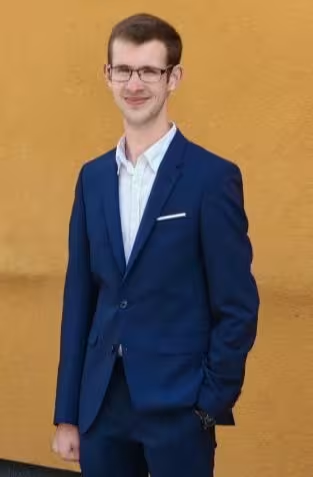
Csongor Cziráki (2003), BA in History (Pázmány Péter Catholic University, 2025).
Intern
Studies in Hungarian
Fraknói Emlékkönyv. Fraknói Vilmos (1843–1924) püspök, történész, a Magyar Tudományos Akadémia főtitkárának emlékezete (CVH I/24), szerk. Tusor Péter–Kanász Viktor, Budapest–Róma 2024, 133–154.
Csongor Cziráki, an intern at the Fraknói Research Group, won first prize in the competition organised by the Hungarian Batthyány Foundation for his paper, Common Interests, Shared Struggle: The Relationship between Captain-General Ádám Batthyány (I) and Bishop György Széchényi in the Light of Their Correspondence.
On 24 September, Tamás Fedeles, Professor at the University of Pécs and Co-Director of the Fraknói Research Group, delivered a lecture at Veszprém Castle as part of the lecture series organised by the Archives of the Archdiocese of Veszprém in connection with the anniversary of the Battle of Mohács. His lecture was entitled “A Bishop’s Mitre on the Battlefield? The Mobilisation and Participation of Ecclesiastical Military Retinues in the Battle and in the Defence of the Kingdom.”
he Fraknói Research Group, in cooperation with Pázmány Péter Catholic University, the University of Pécs, the Pécs Regional Committee of the Hungarian Academy of Sciences, and the Collegium Professorum Hungarorum, organised the 12th Fraknói Summer Academy between 25 and 27 June. This year’s venue was the city of Pécs. The programme focused on late medieval Hungarian ecclesiastical history, centring on the forthcoming 500th anniversary of the Battle of Mohács and the preparation of the Bishops’ Lexicon of the Hunyadi and Jagiellonian periods.
The Bishops’ Lexicon devoted to nineteenth-century Latin-rite prelates, published in 2025 (I–IV, CST I/7), is followed at the beginning of the new year, on the Feast of the Epiphany, by a volume presenting the biographies of the bishops of the Greek Catholic dioceses of Hungary. Spanning 210 pages, the book introduces 31 hierarchs from seven dioceses. As in Chapters I–IV, the introductory descriptions of the Greek Catholic dioceses and the bishops’ biographies in Chapter V are presented in a uniform structure and methodological framework; unlike the earlier volumes, however, the dioceses are here classified and arranged according to the Greek rite rather than by ecclesiastical provinces.
On October 2–3, 2025, the University of Hradec Kralové and the University of Pardubice held a joint international conference on the early modern period entit
Organized by the Veszprémi Szemle Urban History Public Benefit Foundation, the launch event of the 78th issue of the Veszprémi Szemle urban
On the afternoon of 11 September 2025, a double book launch was held at the Somogy County Archives of the Hungarian National Archives. On this occasion, alongside Éva Knapp’s volume Regeneratio et constantia, the source edition The Visitation Records of the Diocese of Veszprém, 1778–1779. III. County of Somogy, published by the Fraknói Research Group’s research fellow Viktor Kanász, was also presented.
Hungary’s Dioceses and Bishops (1804–1918).
The centenary year organized by the Research Group named after Vilmos Fraknói was built on two main pillars: the commemorative conference held in early May in Nagyvárad and the international symposium in Rome. The annotated version of the presentations from the Nagyvárad conference, supplemented with additional studies, writings, and appendices, was published on October 16, 2024, as volume I/24 of the CVH series.
The venue and theme of the Fraknói Academy, held for the tenth time, is justified by the centenary of the death of Vilmos Fraknói (1843–1924) in 2024. Vilmos Fraknói was the main organizer of Hungarian historical research in the Vatican following the gradual opening of the Holy See's collections from 1881. He initiated the Monumenta Vaticana Hungariae, and in the 1890s, using the income from his ecclesiastical benefices, he established the Hungarian Historical Institute in Rome as a private institution. He did not work alone; several others joined the efforts. The roles of his collaborators are important, yet their activities in Rome have not been thoroughly examined by historical scholarship.There is also much to be said about Fraknói Vilmos's years in Rome, his plans, and especially his legacy.