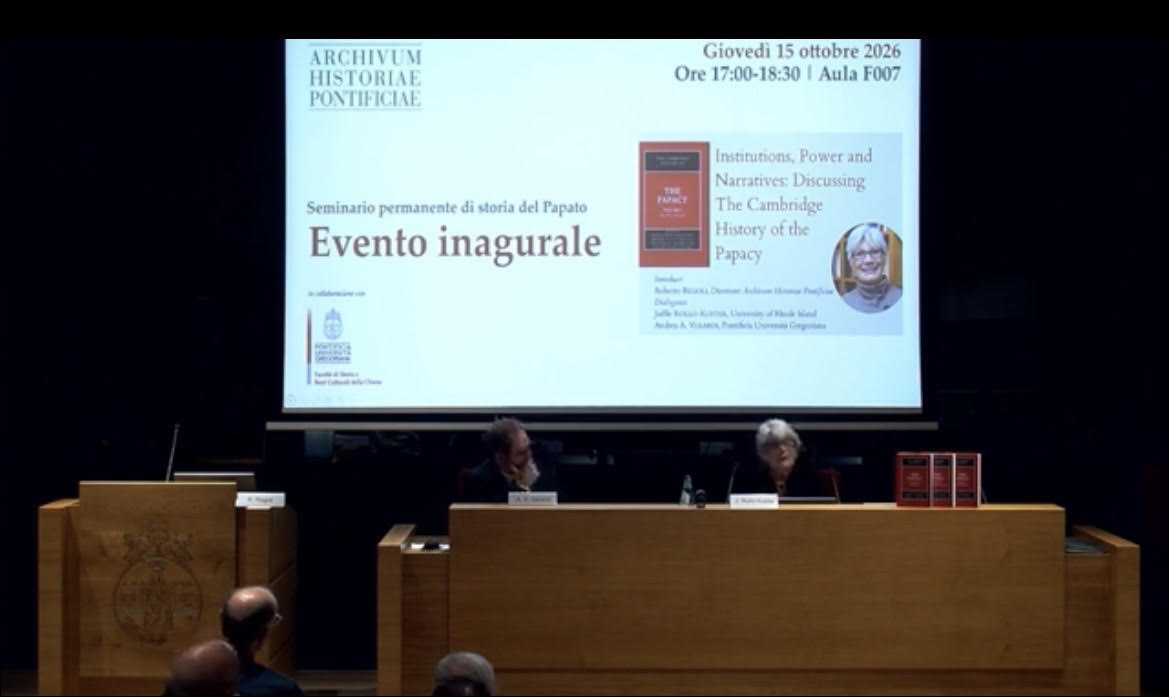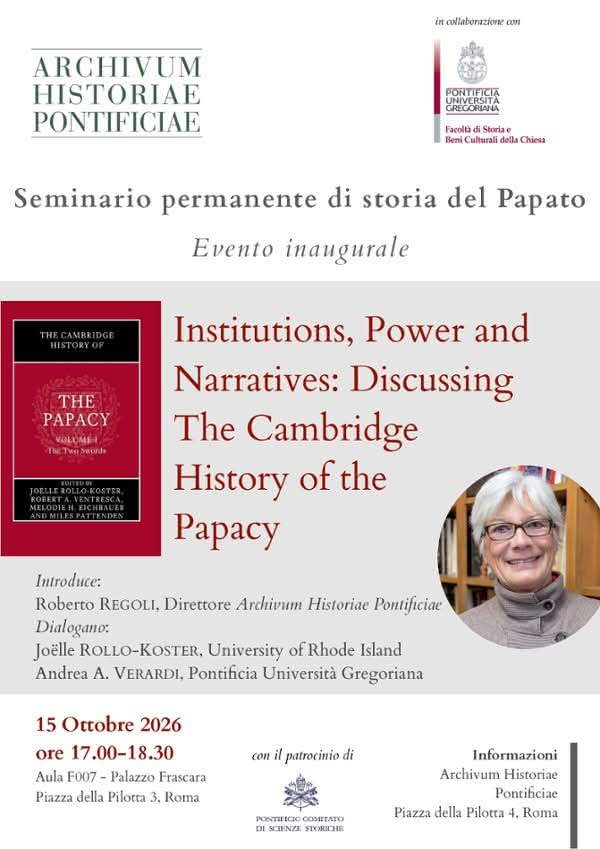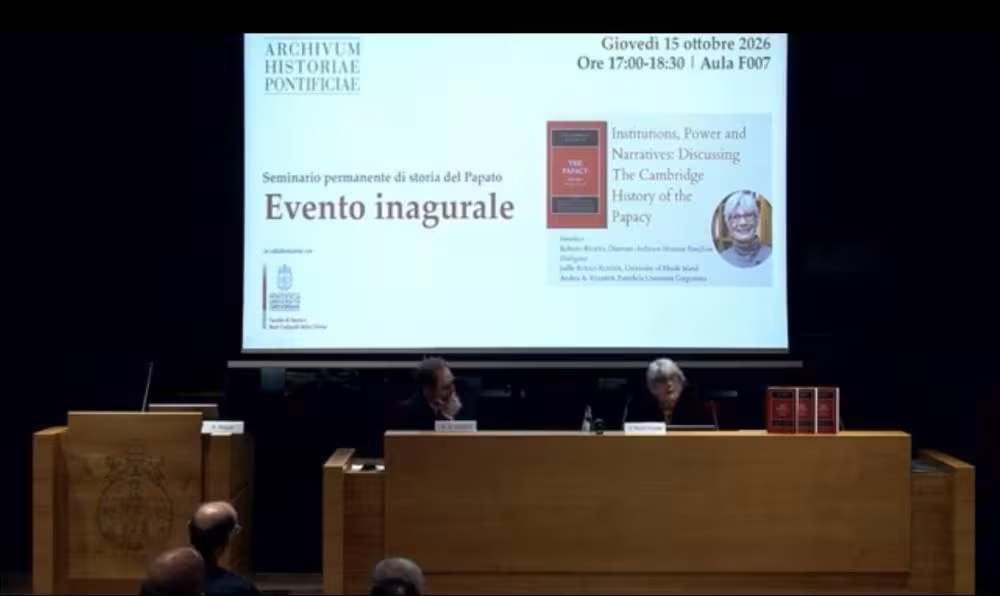
A report by Katalin Nagy, the Fraknói Research Group’s Vatican research resident, on the book presentation Institutions, Power and Narratives: Discussing The Cambridge History of the Papacy.
The permanent seminar on the history of the papacy (Seminario permanente di Storia del Papato) at the Pontifical Gregorian University began its fifth year with a discussion on the afternoon of 15 October of the three-volume The Cambridge History of the Papacy, published by Cambridge University Press in 2025. The work was edited by Joëlle Rollo-Koster (University of Rhode Island), Robert A. Ventresca (King’s University College at Western University), Melodie H. Eichbauer (Florida Gulf Coast University), and Miles Pattenden (University of Oxford).
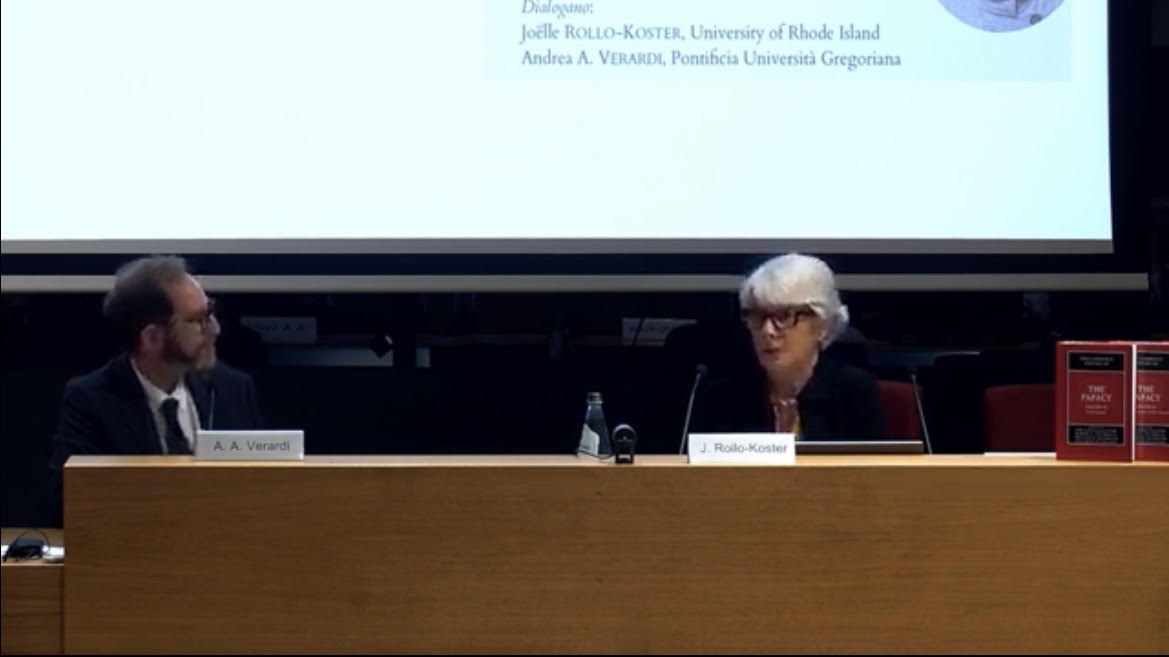
The event opened with remarks by Roberto Regoli, Professor at the Gregorian University and Director of Archivum Historiae Pontificiae. This was followed by a discussion between Joëlle Rollo-Koster, one of the volume’s editors, and Andrea Antonio Verardi (Gregorian University) on the historiographical premises underlying the project.
The discussion centred on the volume’s dual interpretative framework. One strand focused on the concept of “theo-political imagination”: the theological assumptions of the popes and their visions of the papal office and its place within both the Church and the wider world. The other concerned the practice of papal politics—that is, the ways in which this vision manifested itself in domestic affairs, civil society, and international relations. Several chapters explicitly explore the tensions between these two dimensions, comparing declared principles with the actual outcomes of the religious policies they inspired or constrained.
The editors emphasised that the work is neither a collective biography of the popes nor a history of institutional Catholicism, dogmatic theology, or ecclesiastical governance. Their aim was to produce a multidimensional history of the papacy, portraying it as an actor that shaped major events, ideas, and processes in world history while itself being shaped by those same developments. Joëlle Rollo-Koster spoke personally about the origins of the project, admitting that she had initially doubted whether she could bring such an ambitious undertaking to completion. She attributed its success above all to her collaborators: the three-volume work would not have been possible without the joint efforts of the four editors and the contributing authors. The publisher’s role was also discussed. Rollo-Koster highlighted the substantial financial investment made by Cambridge University Press, noting that such support cannot be taken for granted in a scholarly project of this scale.
The most engaging part of the evening concerned the limitations of the work. The discussion drew on reviews published to date, which have raised several recurring criticisms. For instance, not all contributions directly address the four fundamental questions underpinning the project: the pope’s central position within the Church, papal primacy as an instrument of governance, cultural influence, and secularity. Another recurring criticism is the “episodic structure” of the third volume. Rollo-Koster addressed these points directly, openly acknowledging that not all historians appreciate the approach adopted by the editors. From this perspective, the non-narrative structure is not an editorial shortcoming but a deliberate choice. Readers expecting a continuous narrative or a reference work organised like a handbook may be disappointed, since the volume deliberately adopts a problem-centred approach that lies between these two forms.
Jair Santos, a researcher at the École française de Rome, argued that future histories of the papacy should pay greater attention to the Global South and move beyond a Rome-centred perspective when examining colonialism, slavery, and post-conflict reconciliation. The volume has already made some progress in this direction: Justine Walden contributed a chapter on slavery (1500–1800), while Elizabeth A. Foster examined African decolonisation. The question, therefore, is not one of complete omission, but of proportion.
The presentation demonstrated that The Cambridge History of the Papacy does not bring the historiographical debate on the papacy to a close; rather, it opens up new avenues for discussion. Rollo-Koster herself emphasised that one of the project’s principal aims is to stimulate new directions for future research. Perhaps the volume’s greatest achievement lies not in answering every question, but in treating the papacy as a fully fledged actor in world history—and in challenging both historians in general and scholars of the history of the papacy in particular.