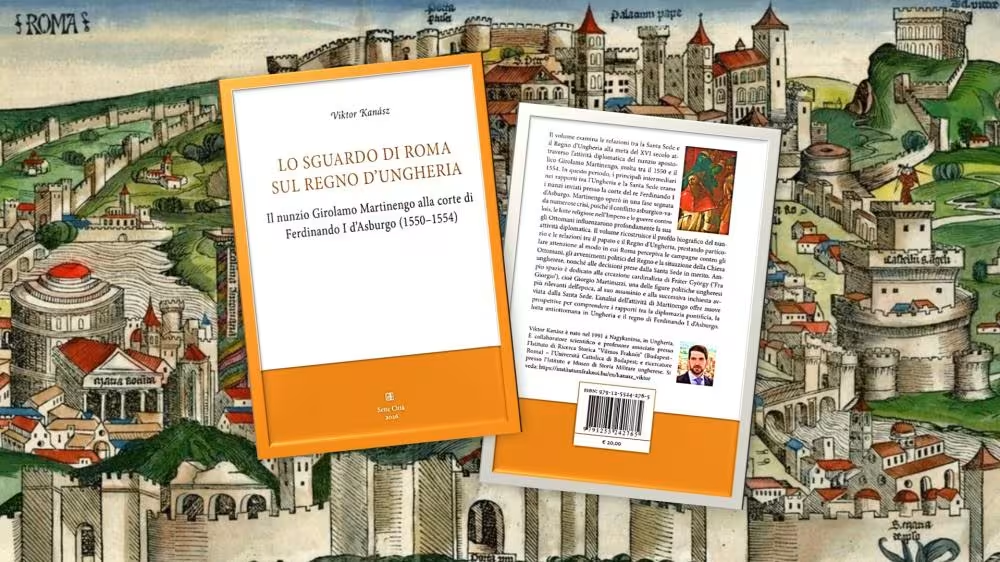
Storia d'Ungheria – History of Hungary is a new international book series published from 2024 by Edizioni Sette Città in Viterbo, co-founded by the Fraknói Research Group, the Collegium Professorum Hungarorum, and the Gyula Moravcsik Institute. Edited by Péter Tusor and Matteo Sanfilippo, this bilingual Italian–English series primarily aims to disseminate the findings of foundational historical research on Hungarian-related materials preserved in Vatican and other Italian repositories directly and widely to the international scholarly community. Furthermore, the editorial board—composed of prominent Italian (Gaetano Platania, Giovanni Pizzorusso, Alessandro Boccolini, Massimo Carlo Giannini) and Hungarian (Kornél Szovák, Tamás Fedeles, Viktor Kanász, Katalin Nagy) historians—intends to accommodate broader studies on Hungarian history in the future. Through these Viterbo publications, and with the active involvement of the Fraknói Research Group, Hungarian historiography has been enriched with its third specialist series of international stature, alongside Collectanea Vaticana Hungariae and Publikationen der Ungarischen Geschichtsforschung.
The recently published monograph by Viktor Kanász, titled Lo sguardo di Roma sul Regno d’Ungheria. Il nunzio Girolamo Martinengo alla corte di Ferdinando I d’Asburgo (1550–1554), represents the fourth volume in the series. The author originally addressed this subject in his 2022 doctoral dissertation, followed in subsequent years by further archival research, the findings of which are now accessible in Italian. The volume examines the mid-sixteenth-century relations between the Holy See and the Kingdom of Hungary through the diplomatic mission of the papal nuncio Girolamo Martinengo between 1550 and 1554. During this period, the primary interlocutors in Hungarian–Holy See relations were the nuncios accredited to the court of King Ferdinand I of Habsburg. Martinengo served at the royal court amidst acute geopolitical instability, as his tenure was fundamentally shaped by the Habsburg–Valois conflict, confessional struggles within the Holy Roman Empire, and warfare against the Ottoman Empire. The study reconstructs the nuncio’s life and the broader framework of pontifical-Hungarian relations, paying particular attention to Rome’s perception of anti-Ottoman military efforts in Hungary, internal political developments, the condition of the Hungarian Church, and the concrete policy decisions formulated in response. In addition, significant emphasis is placed on the elevation to the cardinalate and subsequent assassination of George Martinuzzi (Fráter György)—one of the defining Hungarian statesmen of the era—as well as the resulting Holy See inquest. By analyzing Nuncio Martinengo’s activities, the volume offers novel perspectives on the nexus between papal diplomacy, the anti-Ottoman campaigns in Hungary, and the reign of Ferdinand I of Habsburg. The volume—whose Italian text was edited by Katalin Nagy, research fellow at the CPH and resident Vatican archival researcher for the Fraknói Research Group—is available open-access as a downloadable e-book on the Research Group’s official website.