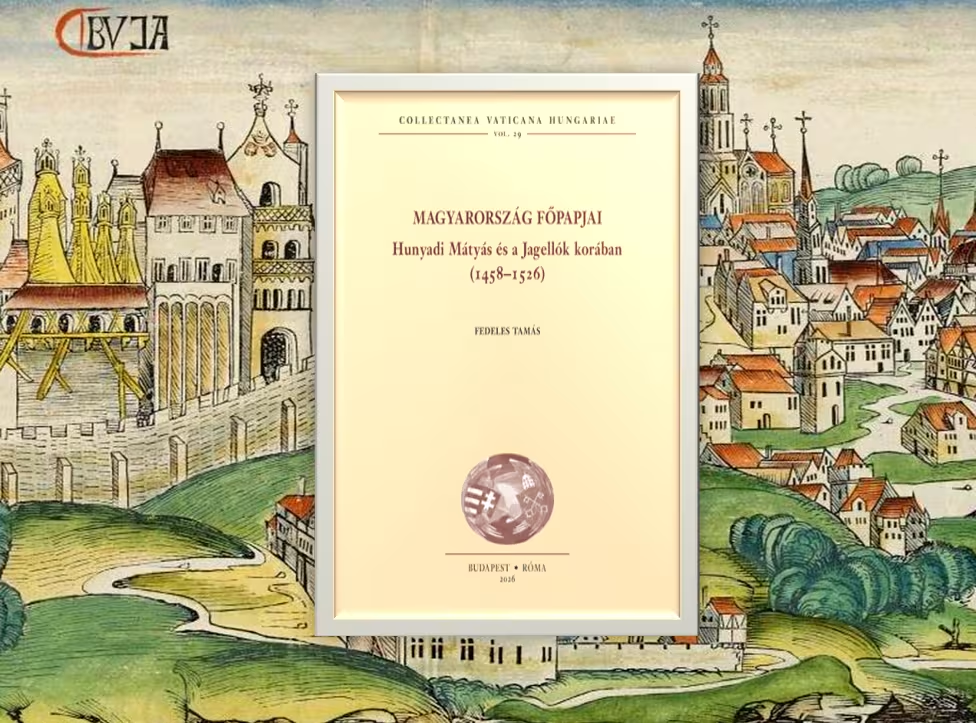
The twenty-ninth volume (I/29) of the Vatican–Hungarian historical series Collectanea Vaticana Hungariae (CVH) has been published. The latest monograph by Tamás Fedeles, Scientific Adviser to the Research Group, marks another important milestone among the research findings presented and published, both orally and in writing, as part of the Fraknói Research Group’s Mohács 500 programme. Unlike volume I/26 of the series, this is not an individual scholarly undertaking conceived and carried out within the Research Group, but the outcome of a joint research project with the Collegium Professorum Hungarorum. The ambitious aim of the project, conducted under the direction of Tamás Fedeles and Norbert C. Tóth, and launched with the contributions of Kornél Szovák and Péter Tusor, was to produce, in time for the 500th anniversary of the Battle of Mohács, a biographical lexicon of the bishops of the Hunyadi and Jagiellonian periods, following the example and methodological model of the nineteenth-century episcopal lexicon. The programme of the 12th Fraknói (Summer) Academy, held in Pécs, was devoted entirely to presenting this project (read more). Tamás Fedeles’s volume, The Prelates of Hungary in the Era of Matthias Corvinus and the Jagiellonians (1458–1526) (Budapest–Rome, 2026), offers a monographic account of the findings achieved to date, ahead of the publication of the ambitious lexicon, now postponed until 2027.
Throughout medieval Europe, prelates governed their dioceses as guardians of the integrity of religious life, providing guidance to their clergy and shepherding the faithful. Their wide-ranging responsibilities extended well beyond the spiritual sphere: they advised monarchs, participated in government, and undertook diplomatic missions. From the Árpádian period onwards, Hungarian prelates and magnates served as members of the royal council, a role reflected in the contemporary Latin designation of the body, prelati et barones. At the same time, as pillars of the universal Roman Church, prelates were bound to the Holy See by an inseparable and indissoluble bond, solemnised by an oath of allegiance to the reigning pope. Medieval prelates were thus characterised by a dual identity and, arising from it, a dual allegiance: at least in theory, they could hold an archiepiscopal or episcopal see in peace only with the consent of both parties, and owed loyalty to the monarch and the pope alike. The prelates of this period maintained close ties with the papacy. Among their number were diplomats in the service of the Holy See, papal legates, and cardinal protectors. Pál Tomori, moreover, led a crusading army into battle on the field near Mohács on 29 August 1526 as captain of the Roman Church. It is therefore fitting that a modern scholarly monograph on the Hungarian bishops of the Hunyadi and Jagiellonian periods should feature in the Vatican–Hungarian historical series; it is no mere coincidence that it appears as its twenty-ninth volume.
This important study, which fills a significant gap in scholarship, offers a comprehensive analysis of the Hungarian episcopate between the election of Matthias Corvinus as king (24 January 1458) and the Battle of Mohács (29 August 1526). The monograph addresses a series of fundamental questions: who was eligible to attain episcopal rank in this period? What were the principal criteria governing episcopal appointments, and which individuals played a role in the selection process? How did networks of patronage and personal connections shape ecclesiastical careers? To what extent did mobility between episcopal sees occur? What characterised the social background of the Hungarian ecclesiastical elite? Was social mobility a feature of the period – in other words, could individuals from lower social strata rise to the episcopate? What connections existed between royal service and ecclesiastical careers? What knowledge and qualifications were expected of a Hungarian bishop at the time? And what were the principal responsibilities of a prelate within his diocese?
The volume also forms an integral part of the research undertaken in connection with the 500th anniversary of the Battle of Mohács. Accordingly, a separate chapter examines the role played by prelates and their military contingents (banderia) in the wars against the Ottomans. Another section is devoted to the participation of archbishops and bishops in the battle of 1526, in which half of the Hungarian episcopate – two archbishops and five bishops – lost their lives in the service of the Kingdom of Hungary and Christian Europe.
The e-book edition of CVH I/29 is available for download here.