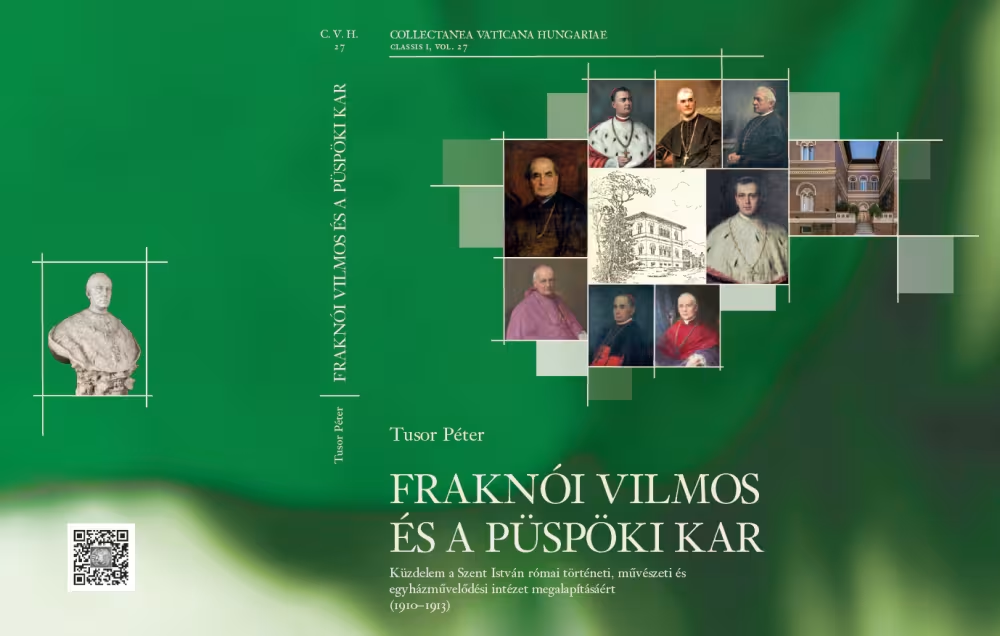
The latest volume of the Vatican–Hungarian historical series (Collectanea Vaticana Hungariae, CVH I/27) bears the title „Fraknói Vilmos és a püspöki kar. Küzdelem a Szent István római történeti, művészeti és egyházművelődési intézet megalapításáért (1910–1913)” (Vilmos Fraknói and the Hungarian Bishops. The Struggle to Establish the Saint Stephen Institute for Historical, Artistic and Ecclesiastical Studies in Rome (1910-1913). The monograph—supplemented with an extensive documentary appendix—forms part of the historiographical research carried out in connection with the Fraknói Centenary of 2024. Its principal findings were first presented at the close of the commemorative year in the framework of the 12th Fraknói Workshop Lecture, under the title „Fraknói Vilmos és a püspöki kar. A római történeti intézet alapítástörténetéhez” (Vilmos Fraknói and the Episcopate: Toward the Founding History of the Hungarian Historical Institute in Rome). That lecture, however, examined and analysed the events only up to the failure of the official foundation of Fraknói’s Roman historical institute in January 1912.
The present monograph offers the first comprehensive treatment of the entire subject. Its most significant result lies in demonstrating that the history of the proposed Hungarian ecclesiastical institute in Rome—an issue of considerable symbolic importance—allows for a deeper understanding of the intellectual horizons of the Catholic ecclesiastical elite at the turn of the twentieth century, while also revealing their internal divisions with far greater clarity than before. Through a dense body of evidence documenting the tension between a partly pragmatist, partly paternalist and aristocratic conservatism, on the one hand, and an organised ecclesiastical “progression”—represented and mobilised not only by Ottokár Prohászka but also by Vilmos Fraknói—on the other, the study demonstrates conclusively that Hungarian Catholicism around the turn of the century cannot be regarded as a monolithic entity. This conclusion remains significant even though both external circumstances and internal power relations changed profoundly after the First World War. In the Hungary of the late nineteenth and early twentieth centuries, Vilmos Fraknói himself represented a form of patriotic elitism marked by a pronounced sense of social responsibility, situated within the intellectual frameworks of Romantic historicism and modern Catholicism.
The history of Fraknói’s projected Roman institute and the successive institutional concepts associated with it reveal that the strengthening of Catholic identity at the fin de siècle was accompanied by processes of ideological segregation and clericalisation. The chronological framework of this development spans 1894–1914—from the establishment of a privately maintained institute at Fraknói’s own residence, through the attempt to create a state-academic private institute, to the ultimately unsuccessful efforts to found an institute under ecclesiastical patronage or with an explicitly ecclesiastical character.
Grounded firmly in historical research, the volume also succeeds in definitively dispelling and clarifying the confabulatory origin myths that currently connect several Hungarian institutions operating in the Eternal City with the name of Fraknói. The essence of this clarification is that while the concept formulated by Kunó Klebelsberg, centred on fostering Italian–Hungarian cultural and diplomatic relations, continues to shape the Hungarian institutional presence in Rome, Fraknói’s scholarly legacy lacks an institutional base in the Italian capital. No Hungarian ecclesiastical or state-supported historical research institute or artists’ house presently exists in Rome. At the same time, however, certain intellectual antecedents of the Pontifical Hungarian Institute—which maintains only a latent connection with Fraknói’s legacy and does not express it in its official self-definition—can be discerned in Fraknói’s February 1912 proposal, as well as in the negotiations conducted under the leadership of Bishop Károly Hornig until November 1912. Moreover, the Saint Stephen House may clearly be regarded as the actual—albeit partial—realisation of the scholar–abbot’s plan of 20 August 1910, which sought to revive the medieval tradition of the pilgrims’ house bearing the name of Saint Stephen. Paradoxically, this is precisely the institution that does not in any way trace its origins to Vilmos Fraknói.
Alongside these two principal historical arguments, the volume presents a series of smaller but illuminating findings related to Fraknói’s biography. Among other matters, the reader learns why he was compelled to leave Rome permanently in 1905, how his relations developed with his fellow canons in Nagyvárad (Oradea) and with Count Miklós Széchényi, the bishop of the diocese, as well as several details of his journey to India in 1910 and his visit to the United States in 1912. The study also discusses his plans for a synthesis in cultural history, his 1914 resignation from the abbacy of Szentjobb and from his canonry in Várad, and the rapid withdrawal of that resignation. These and similar episodes—many of which were either absent from or only briefly mentioned in the centenary memorial volume devoted to him—add further depth to the portrait of the scholar and churchman.
The intricate and thought-provoking sequence of events has thus far been presented in lecture form only up to January 1912. Fraknói’s subsequent new project—the plan for the Saint Stephen Institute for Ecclesiastical Culture in Rome—will be the subject of a forthcoming lecture to be delivered at the Saint Stephen Academy in the autumn of 2026.
The volume, edited by Olivér Kőhalmi, can be viewed and downloaded in full here.